


Usage Risers and Fallers: What the Snap and Target Trends Say Through Week 7
Usage moves before the box score does. Here are the players whose snap share, target share, opportunities, or red-zone touches changed the most over the last four weeks of the 2026 season, by position, with the exact number behind every move. As always, we describe what the usage did, not why it did it.
Blake Corum: fantasy points and matchups


Usage is the part of a fantasy profile that moves first. A back who starts handling 18 touches a game, or a receiver whose target share jumps ten points, is telling you about his next few weeks before the points catch up. So every week we read our usage-momentum board, which tracks how four things trend over a rolling four-week window: snap share, target share, opportunities (carries plus targets), and red-zone touches. Below are the biggest movers by position through Week 7, with the exact window-average-to-current number behind each one.
One honest boundary first, the same one we hold every week. This edition describes which stat moved, not why it moved. We can show you that a snap share collapsed or a target share doubled, because that is in the data. We do not claim the reason (an injury, a benching, a game script that forced the pass) because that causal data is not in our pipeline yet. When you see a usage cliff here, read it as a flag to go check the why yourself, not as our explanation of it.
And the credibility layer, because a usage read is only worth the record behind it. Our graded start/sit calls across 2024 and 2025 hit 77.2% overall on 15,216 calls, and we publish that number win or lose. Only players who clear a usage noise floor make this board (at least three weeks of data and a real snap count), so a single-game blip does not sneak a name on.
Risers
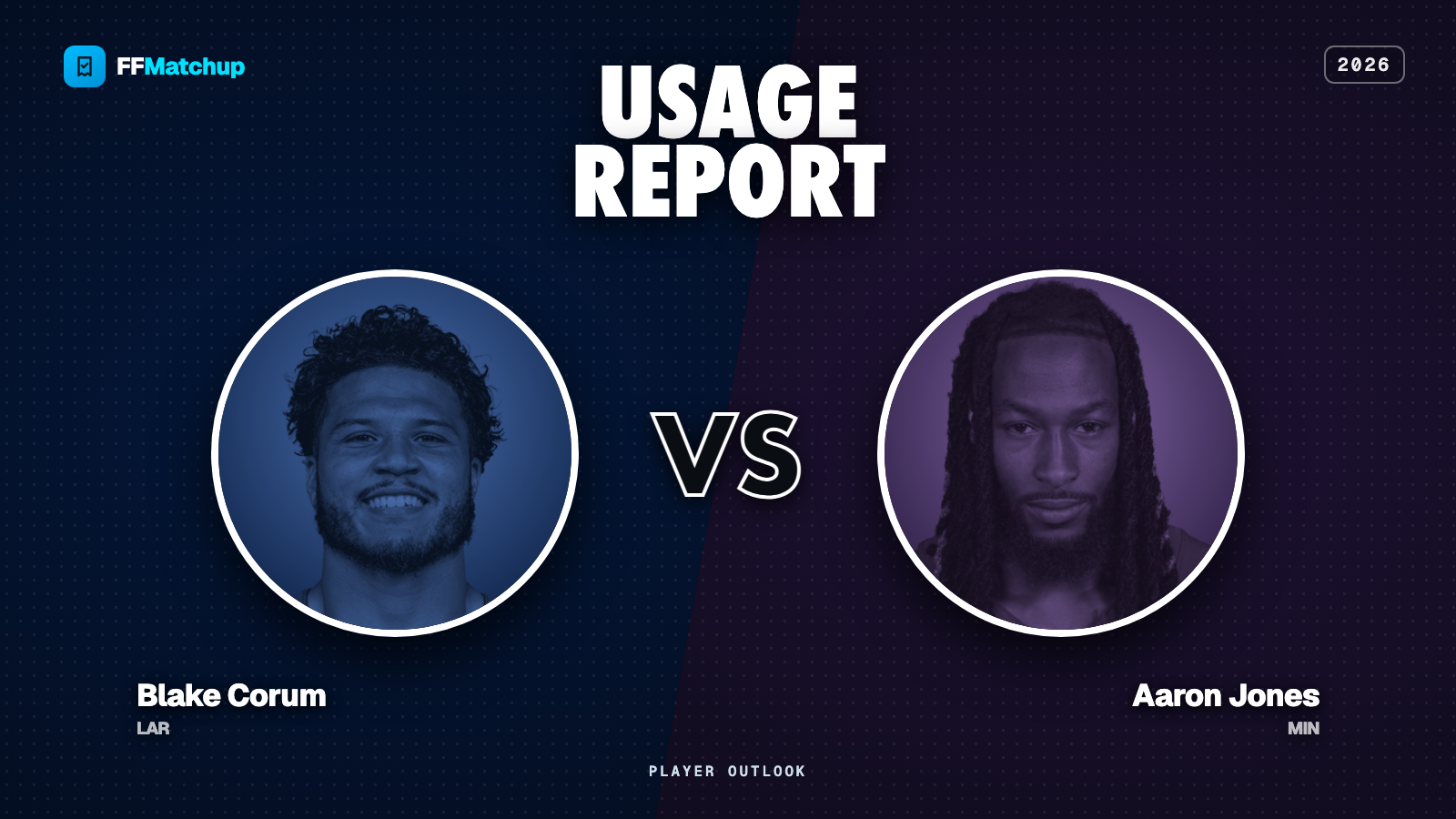
Running back. Blake Corum is the cleanest climb at the position: opportunities up from a four-week average of 11.2 to 18, red-zone touches from 2.5 to 6, and snap share from 28% to 44%. On the same board his backfield mate Kyren Williams is falling the other way, so the Rams workload is now an even 18-to-18 split. Bucky Irving is the high-volume riser, opportunities 22 to 26, red-zone touches 5 to 8, and target share 9% to 18%. Ollie Gordon II moved hardest by volume, opportunities 19 to 28 on a snap share climbing 68% to 83%.
Wide receiver. Elic Ayomanor has one of the board's biggest wideout moves: snap share from 66% to 89%, target share from 10% to 23%, and opportunities from 3 to 7. Emeka Egbuka is the bankable name still climbing, his target share up from 30% to 39% and opportunities from 10 to 16 on a steady 86% snap share. Jalen Nailor jumped in playing time, snap share 54% to 75% with opportunities 3 to 5 and target share 7% to 12%.
Tight end. Dalton Kincaid is the most usable riser here: target share up from 15% to 27%, opportunities 4 to 8, and red-zone touches 1.3 to 4, the kind of move that matters most at a volume-dependent position. Greg Dulcich doubled his target share toward the ceiling, 14% to 24%, with opportunities 3.3 to 5. Colby Parkinson climbed more gently, target share 14% to 21% and opportunities 4.7 to 6, off a small sample at a volatile position.
Fallers
Running back. Aaron Jones is the sharpest drop at the position: opportunities from a four-week average of 21.7 to 9, snap share from 62% to 25%, and target share from 13% to 4%. That is a near-halving of the workload in the latest week, and it is the first name to run down before you set a lineup. Kyren Williams slid as well, snap share 70% to 51% and opportunities 21.8 to 18; note that his backfield mate Blake Corum moved the opposite way on this same board. Keaton Mitchell fell off a smaller base, opportunities 9.7 to 3 and target share 14% to 3%.
Wide receiver. Romeo Doubs is the steepest wideout decline: snap share from 50% to 3%, target share from 13% to 3%, and opportunities from 4.3 to 1. Mike Evans slid as well, snap share 54% to 40%, target share 28% to 18%, and opportunities 7.7 to 5. Davante Adams is the softer, watch-it move: opportunities 6.7 to 4 and red-zone touches 1.7 to zero, though he still held a 74% snap share.
Tight end. Isaiah Likely carries the position's steepest usage drop: opportunities from 10 to 4 and target share from 28% to 15%. Sam LaPorta is the one to read carefully: he was on the field more than ever (snap share 88% to 97%), but the targets left anyway, target share 16% to 6% and opportunities 6.7 to 2. Darren Waller declined more gently, opportunities 3.3 to 2 and target share 9% to 7%.
A note on quarterbacks
Quarterback usage momentum is mostly noise. Starters play close to 100% of snaps every week, so the only part of their usage that actually moves is designed runs and scrambles, and that swings game to game. The one clean signal through Week 7 is J.J. McCarthy, whose snap share climbed from a four-week average of 46% to 92% as he moved into a full workload. We flag the position lightly on purpose rather than forcing four names onto a board that does not really have them.