Draft the Role, Not the Line: The Best Fantasy Bets on 2026's Worst Offensive Lines
Our new offensive-line ranks put Cleveland, the Chargers, Las Vegas, Kansas City and Minnesota among the shakiest fronts in football. History says it barely dents the right players: top-10 receivers and tight ends come off bottom-10 lines every year, and even rookies pull it off. Here are the prospects whose usage travels, and the one group you should still fade.
Brock Bowers: fantasy points, matchups, and our calls


We just added real offensive-line data to the model's world: pressure rate allowed and yards before contact per rush, aggregated to a team rank. The 2026 bottom of the board is Cleveland, the Chargers, Las Vegas, Kansas City and Minnesota. The instinct is to fade everyone in those offenses. The history says do the opposite for the right players.
Across the last three seasons, top-10 fantasy finishers came off bottom-10 lines all the time: roughly one in six top-10 receiver seasons and nearly one in three top-10 tight end seasons were produced behind a bottom-10 protection. Top-10 running backs did it far less, about one in eight, and almost always through the passing game. The lesson is simple: a bad line discounts the price, not the volume. Target share and route participation do not care who is blocking.
The alpha receivers: target share beats pressure
Justin Jefferson is the headline case: a 38.6% air-yards share on 141 targets in 2025 with a shaky front, and a WR2 finish in 2024 behind the same kind of line. Nico Collins is the same story in Houston (23rd-ranked line): 120 targets, 1,117 yards and a 33.3% air-yards share, a top-10 season behind bad protection. In Jacksonville (25th), Brian Thomas Jr. is the vertical alpha at a 14.45 aDOT and a 27% air-yards share, and the Chargers' Ladd McConkey ran a 23.8% air-yards share on 106 targets despite the 31st-ranked pass protection. The line is the reason the market hesitates. The usage is the reason you should not.
The every-down tight ends: the most line-proof position
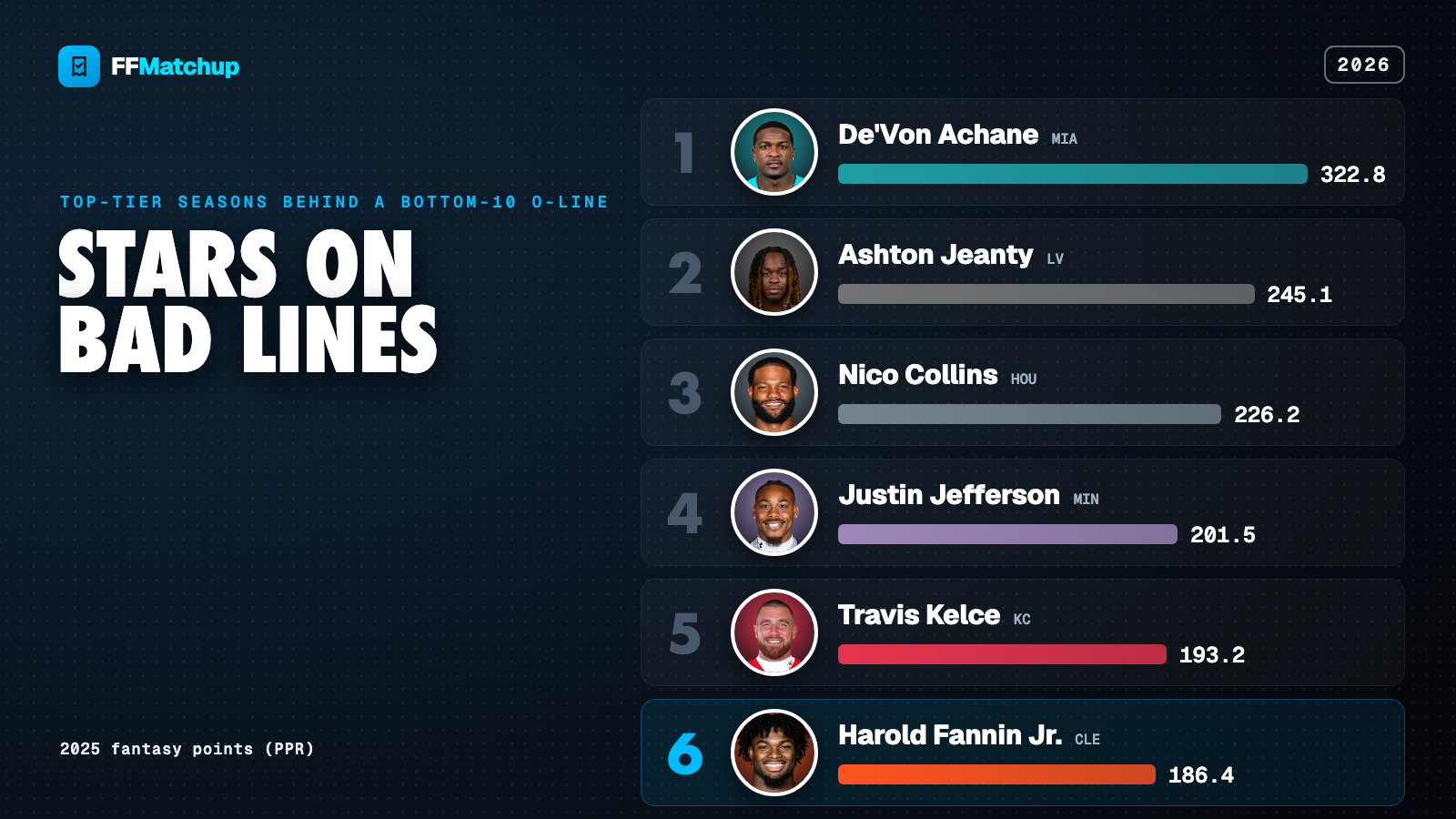
Tight end is the least line-dependent position in fantasy, because they chip and release, work underneath at low depth, and score on target share and red-zone role. Brock Bowers is the proof: he was the TE1 as a rookie in 2024 behind a bottom-10 Las Vegas line, and drew 86 targets in just 12 games in 2025. Travis Kelce has posted 108 targets behind a middling Kansas City front and keeps finishing as a starter. And the cleanest rookie proof of all: Harold Fannin Jr. caught 72 balls for 731 yards and finished as a top-five tight end as a rookie behind Cleveland's 32nd-ranked line, the worst in football.
The receiving backs: the only runners who travel
Running back is where a bad line actually bites, with one exception: backs who catch passes. De'Von Achane is the blueprint, a top-five back in 2025 on 85 targets and 67 catches behind Miami's bottom-10 run blocking. Ashton Jeanty is the talent exception: even Las Vegas's 31st-ranked run blocking could not stop a top-five rookie season, and he added 55 receptions to insulate the floor. The tell for the fade is the opposite profile: a pure between-the-tackles back with no receiving role behind a bottom-10 run-blocking line has nowhere to hide.
The rookies walking into it
Rookies clear this bar every year. Malik Nabers posted 170 targets, 109 catches and 1,204 yards as a rookie in 2024 behind the Giants' 31st-ranked pass protection, a top-six receiver season out of the gate. Fannin and Jeanty just did it in 2025, and the Chargers' Omarion Hampton flashed a top-10 back pace before his rookie year was cut short. The incoming class lands in the same target vacuums: Cleveland's worst-in-the-league line still needs pass-catchers, and rookies KC Concepcion and Denzel Boston are on the board there with no NFL snaps yet but a clear runway, alongside Jerry Jeudy and his 35.9% air-yards share. Draft the projected role, not the line grade.