Fantasy 2026 Goal-Line Backs: Who Owns the Touchdown Equity (and the Committee Traps)
Goal-line touches are the stickiest source of rushing touchdowns, so the backs who own their team's stripe are the safest scoring bets. But the leaderboard alone lies. Snap share is what separates a bell cow you can start every week from a committee back who owns the goal line and still sits on a third of the snaps.
Jonathan Taylor: fantasy points, matchups, and our calls


Rushing touchdowns are the hardest fantasy production to project, because touchdowns are noisy. The one input that carries year to year is opportunity at the goal line. The backs who own their team's short-yardage and goal-line work are the ones whose touchdown totals rest on a repeatable role rather than luck. So a goal-line-touch leaderboard is a genuinely useful board. The problem is that the leaderboard alone will fool you. A back can top it and still be a part-time player who leaves the field on passing downs, which is a very different fantasy asset than a workhorse who owns the stripe and never comes off. The tiebreaker is snap share, and it splits this list into two very different kinds of bets.
The safest bets: own the stripe and stay on the field
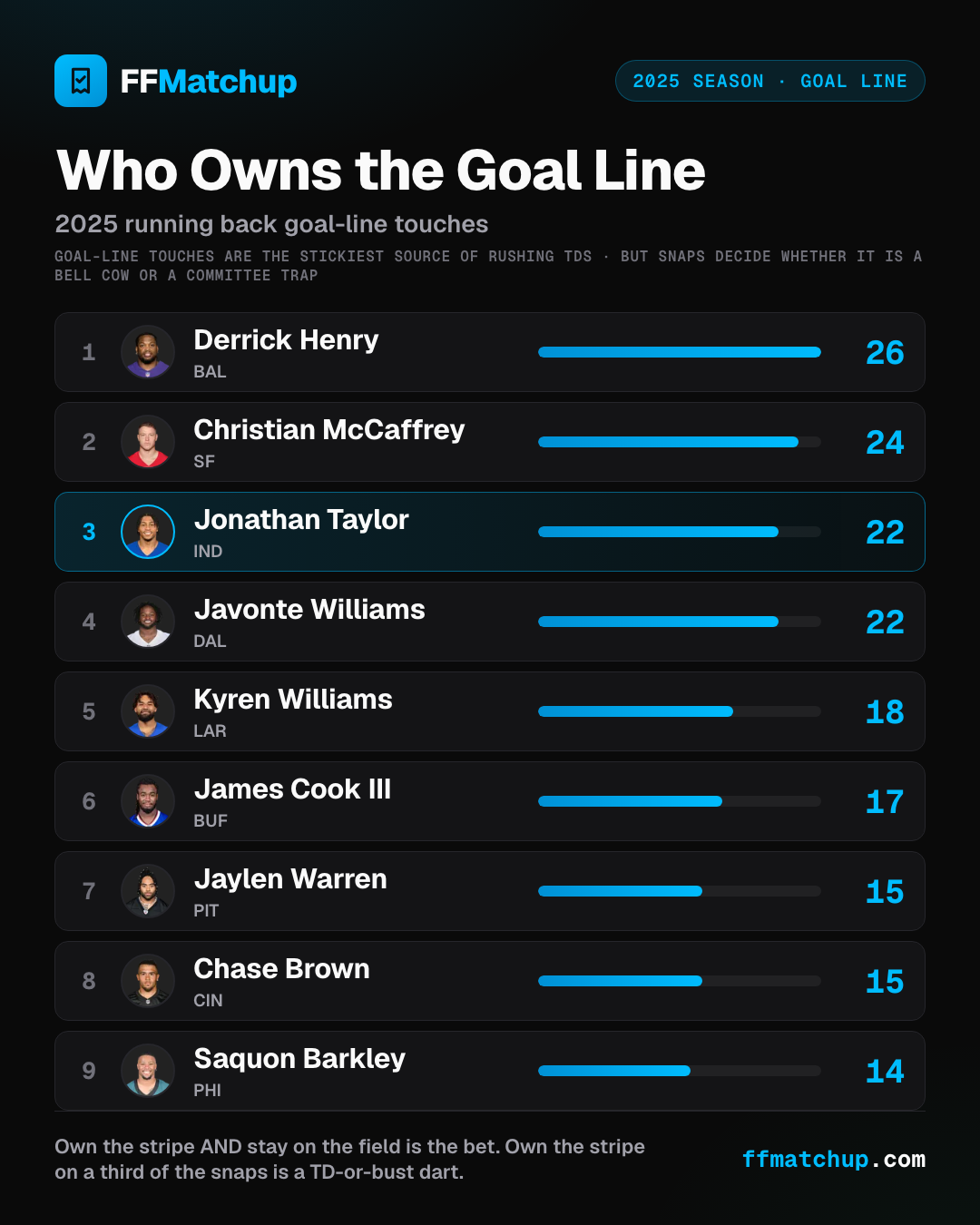
The backs you can start without thinking are the ones who combine goal-line ownership with a full-time snap share. Jonathan Taylor is the model: 22 goal-line touches, a league-high 18 rushing touchdowns, and an 83 percent snap share on 323 carries in 2025. He owns the scoring role and never leaves the field, so both his floor and his ceiling are secure. Christian McCaffrey is the same profile with a receiving engine bolted on: 24 goal-line touches, 83 percent of snaps, and 102 catches, which is the highest-floor back in fantasy. Saquon Barkley at 14 goal-line touches on a 78 percent snap share and Javonte Williams at 22 goal-line touches on 69 percent round out the group. These are the backs where the goal-line number and the snap number agree, and they price accordingly as top-of-draft picks.
The volume king who is still a two-down back
Derrick Henry leads football in goal-line touches with 26 and ran in 16 touchdowns, so his scoring equity is not in question. But he played only a 55 percent snap share and caught 15 passes all season, which means his fantasy value is almost entirely rushing and touchdown driven. In a standard or PPR league that is still a strong every-week starter because the volume and touchdown rate are so high, but it is a different asset than a McCaffrey or a Taylor. Henry is a touchdown-and-yardage back with a thin receiving floor, so his weekly range is wider: when the touchdowns come he wins your week, and when they do not the catch-light usage gives him less to fall back on. Know which kind of back you are buying at his price.
The committee traps: own the stripe, sit two-thirds of the snaps
This is where the leaderboard is most dangerous. Some backs post real goal-line numbers on a part-time snap share, and those are touchdown-or-bust darts rather than reliable starters. Blake Corum is the cleanest example: he took 13 goal-line touches in 2025, but on just a 29 percent snap share behind Kyren Williams, who owns the Rams backfield at 18 goal-line touches and a 68 percent snap share. Corum will vulture touchdowns, but he plays too little to trust weekly unless Williams misses time. The other trap is the quarterback who eats the goal line himself. James Cook III took 17 goal-line touches and scored 12 rushing touchdowns, a strong line, but Josh Allen took 16 goal-line touches of his own and ran in 14 touchdowns, so the Buffalo short-yardage work is a genuine split between back and quarterback. Cook is a fine starter on volume, but do not project his touchdown share as if he owns the stripe outright.
How to use it on draft day
Read the goal-line board with the snap column open. The backs who own the stripe and play a full-time snap share, Taylor, McCaffrey, Barkley, Williams, are the safe touchdown bets, and they cost early-round capital because that certainty is scarce. Henry is the volume king with a thin receiving floor, a strong start with a wider weekly range. The committee traps, backs like Corum who post goal-line numbers on a part-time role, and the quarterback-capped situations like Cook and Allen, are the ones to price carefully: real touchdown upside, but not the every-week floor the raw number implies. Our player pages carry the goal-line, inside-10, and snap splits on every back, so you can run this same check on anyone the board hands you before you spend the pick.