The Goal-Line Running Backs: Who Owns the Touchdown Equity for 2026
Rushing touchdowns are the noisiest part of a running back's fantasy line. The share of a team's red-zone carries is not. Here are the backs who owned the goal line in 2025, why that number predicts next year's scoring better than last year's touchdown total, and where the share hides a committee.
Ashton Jeanty: fantasy points, matchups, and our calls


Touchdowns are the part of a running back's fantasy line you can least trust from one year to the next. A back can lose three scores to a bad bounce or a vulture and drop 40 PPR points through no change in his role. So the useful question in August is not who scored the most rushing touchdowns last year. It is who owned the carries where touchdowns come from. That is the share of a team's red-zone rushes, and it is a lot stickier than the scores themselves.
First the credibility layer, because a read on usage is only worth the record behind it. Our graded start/sit calls across 2024 and 2025 hit 77.2% overall on 15,216 calls. At running back specifically, our green calls finished startable 70.0% of the time versus 9.9% on red. We publish that number win or lose. Read what follows as the usage that scoring roles are built on, not a promise about any one back's touchdown count.
Why goal-line share beats last year's touchdown total
Red-zone carry share is a role number, not an outcome number. It measures how much of a team's rushing work inside the 20 goes to one back, and coaches hand that role out deliberately: the guy they trust in short yardage keeps getting the ball there. Raw touchdown totals mix that role together with a season of coin-flip finishes at the goal line. Strip the noise out and the role is what carries forward, which is why a high red-zone carry share is a better 2026 touchdown-equity board than a list of last year's leading scorers.
The board: who owned the red zone in 2025
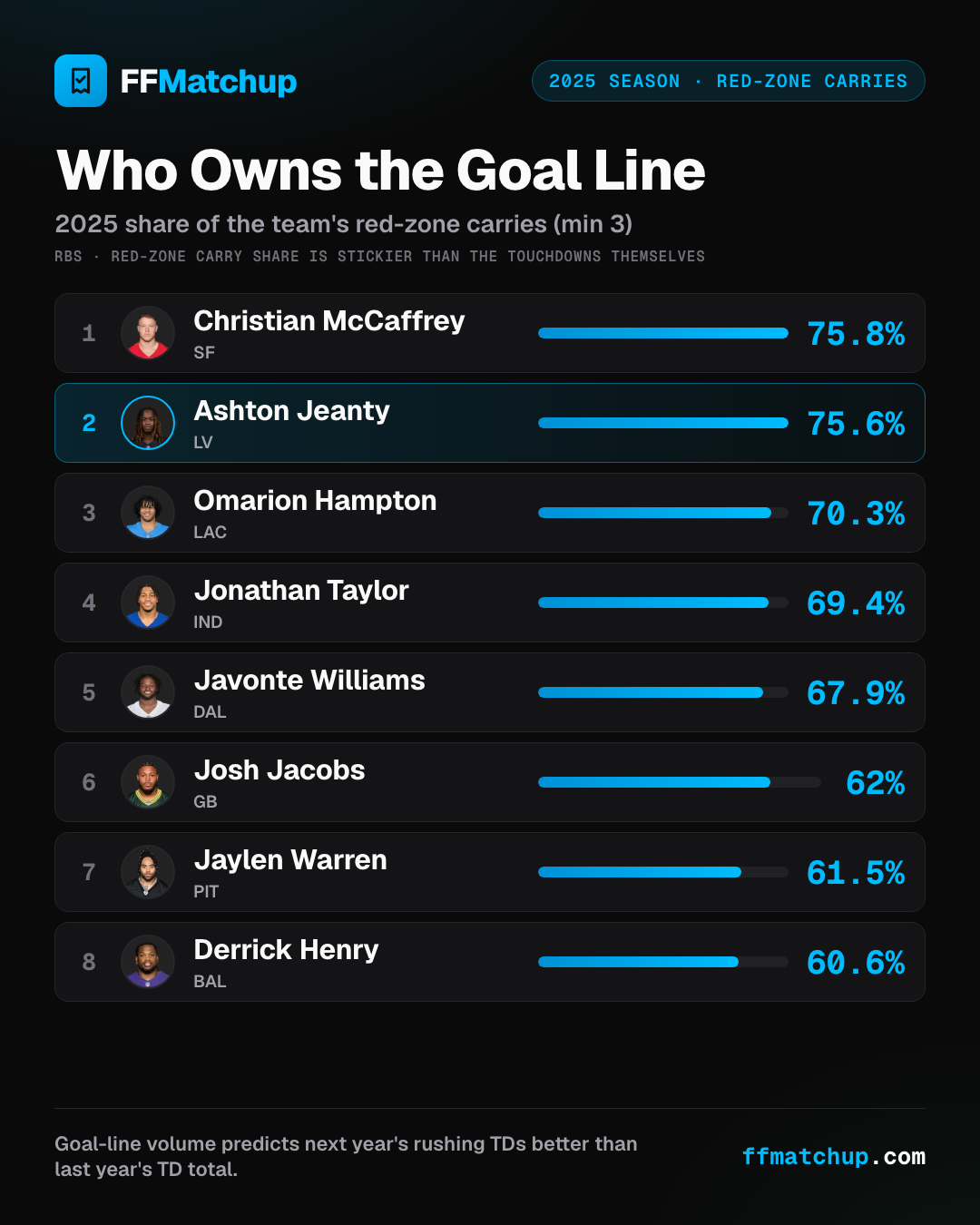
The 2025 leaders in share of their team's red-zone carries (minimum 3 carries): Christian McCaffrey at 75.8% (75 of San Francisco's 99), Ashton Jeanty at 75.6% (34 of 45), Omarion Hampton at 70.3%, Jonathan Taylor at 69.4% (68 of 98), Javonte Williams at 67.9%, Josh Jacobs at 62.0%, Jaylen Warren at 61.5%, and Derrick Henry at 60.6% (60 of 99). These are the backs whose coaches funnel the scoring work to one man instead of splitting it.
Ashton Jeanty is the positive-regression bet
Jeanty is the name on this board the market has not fully caught up to. As a rookie he already owned 75.6% of the Raiders' red-zone carries and took 34 red-zone rushes and 10 goal-line touches, elite volume for a first-year back. What did not follow was the scoring: he ran that workload into just 5 rushing touchdowns on 266 carries. That is a low conversion rate for the volume, and conversion is exactly the part that regresses. The role that produces the touchdowns is already his; the touchdown count is the thing most likely to climb.
Here is the honest other half. Share is a percentage of a pie, and Las Vegas's red-zone pie was small. Their 45 team red-zone carries were the fewest of any full-season back on this board (Omarion Hampton's Chargers show 37, but over just nine games), well under San Francisco's 99 or Indianapolis's 98. Jeanty owns nearly all of a modest workload, so his absolute goal-line volume is capped until the Raiders offense gets into scoring range more often. The bet on positive touchdown regression is real, but it is partly a bet on the offense around him improving, not on his role, which is already maxed.
Owning the 20 is not the same as owning the goal line
One caution the raw board hides: red-zone carry share counts everything inside the 20, and the actual goal line can still be a committee. Jahmyr Gibbs is the clean example. He led Detroit with a 60.0% red-zone carry share and 51 red-zone carries, which reads like ownership. But at the true goal line, David Montgomery took 14 goal-line touches to Gibbs's 12. Gibbs owns the work inside the 20; the short-yardage scores are split. Before you buy any back on this list as a touchdown lock, check whether his goal-line touches match his red-zone share or whether a bigger back is stealing the last two yards.
That is why the safest touchdown bets on the board pair a high share with a big absolute pie. McCaffrey (75 of 99), Jonathan Taylor (68 of 98), and Henry (60 of 99) each own most of a red zone their offense visits often, so both the role and the volume are working for them. That combination, not a single gaudy touchdown total, is what a 2026 touchdown-equity read should be built on.