Zero-RB strategy 2026: when it works, when it backfires, and what the draft board actually says
The early board is drowning in wide receivers and thin on bell-cow backs. Here is when passing on running backs pays off, and the two ways it costs you a season.
Ja'Marr Chase: fantasy points, matchups, and our calls


Zero-RB is not a personality test. It is a bet about supply. The question is never "do I like running backs," it is "where is this specific draft board giving away startable production, and where is it charging a premium for risk." In 2026, the board answers that question loudly, and it is worth reading before you talk yourself into three straight running backs.
Start with what is actually available early. On our current draft board (snapshot 2026-08-24), fourteen of the top twenty-four players by PPR ADP are wide receivers. Only eight are running backs, and just four backs go inside the top twelve overall. Push the window out to the top sixty and it is twenty-nine wide receivers to twenty-one backs. Receiver is the deepest it has been in years. You can leave the first two rounds with two of Ja'Marr Chase, Puka Nacua, Jaxon Smith-Njigba, Amon-Ra St. Brown, or CeeDee Lamb and still find a genuine WR2 with a real target share sitting in the fourth and fifth rounds. That glut is the entire engine of the strategy.
When zero-RB works
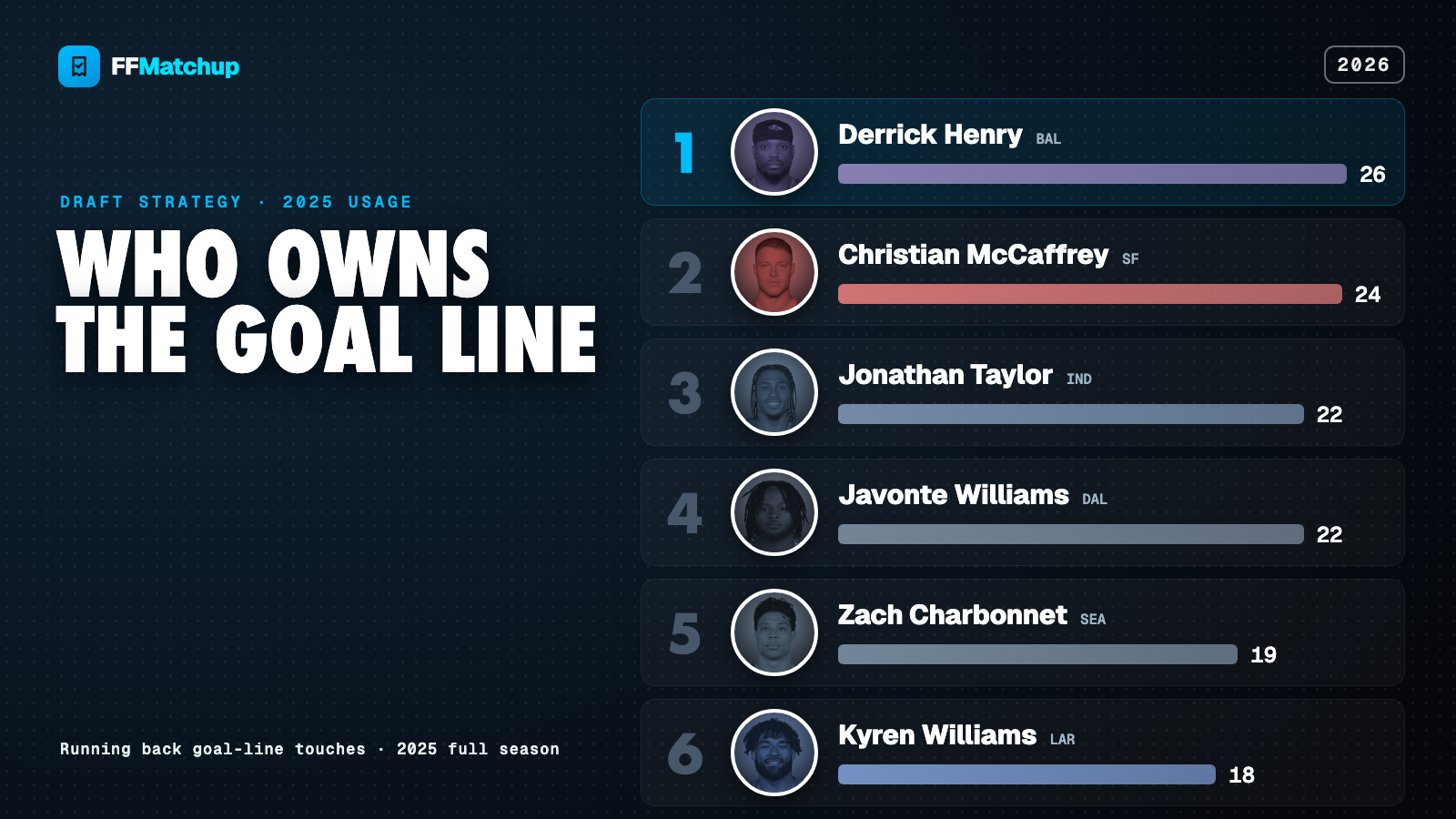
Zero-RB works when two things are true: startable receivers keep falling to you, and the running back pool has few backs worth reaching for. Both are true in 2026. Only about ten backs earned true bell-cow goal-line volume last season. In 2025, Derrick Henry took 26 goal-line touches, Christian McCaffrey 24, Jonathan Taylor and Javonte Williams 22 each, and by the tenth back on the list you are already down to Chase Brown at 15. Below that tier, scoring runs through committees. If the pool of backs you actually trust is that small, and most of them are already gone by the end of round two, then reaching for the eighth or ninth back off the board means paying a first-tier price for third-tier certainty.
Meanwhile the receiver room keeps handing you volume. When your WR2 and WR3 come with 25-plus percent target shares and downfield roles, you build a weekly ceiling that committee backs cannot match. Our coverage and defense-versus-position data then does the rest in-season: you stream the running back position off matchup rather than draft capital, and you let our graded start/sit calls tell you which of your cheap backs to trust each week.
When it backfires
There are exactly two ways zero-RB blows up, and both are avoidable.
The first is the running back dead zone. On this board the backs ranked roughly eighth through twenty-first are crammed between pick 24 and pick 60, from Saquon Barkley near pick 25 down through a wall of committee options. If you punt running back entirely and then panic-draft three of those backs in a row in the fifth and sixth rounds, you have not run zero-RB. You have run late-RB into the worst part of the board and stacked three timeshares. The whole point is to be selective, not to defer the same bad decision two rounds later.
The second is ignoring workload before you buy. A cheap back is only useful if he touches the ball at the goal line or catches passes. Chase Brown is the model of what to target late-ish: he cleared 15 goal-line touches and owns his backfield, with Samaje Perine at just four. Contrast that with the committee backfields our player pages flag, where the handcuff quietly takes the stripe. Run the competitor check on every back you draft: who else eats the goal-line and third-down work. If you cannot answer, do not spend the pick.
Zero-RB in 2026 is a strong default, not a religion. Take the falling receivers early because the board is forcing them on you, then attack running back with intent rather than panic. Use our value board to find the backs the market is underpricing, our goal-line and snap data to confirm they actually own a role, and our weekly graded calls to set your flex. The managers who lose with zero-RB are not the ones who waited on running back. They are the ones who waited and then drafted scared.