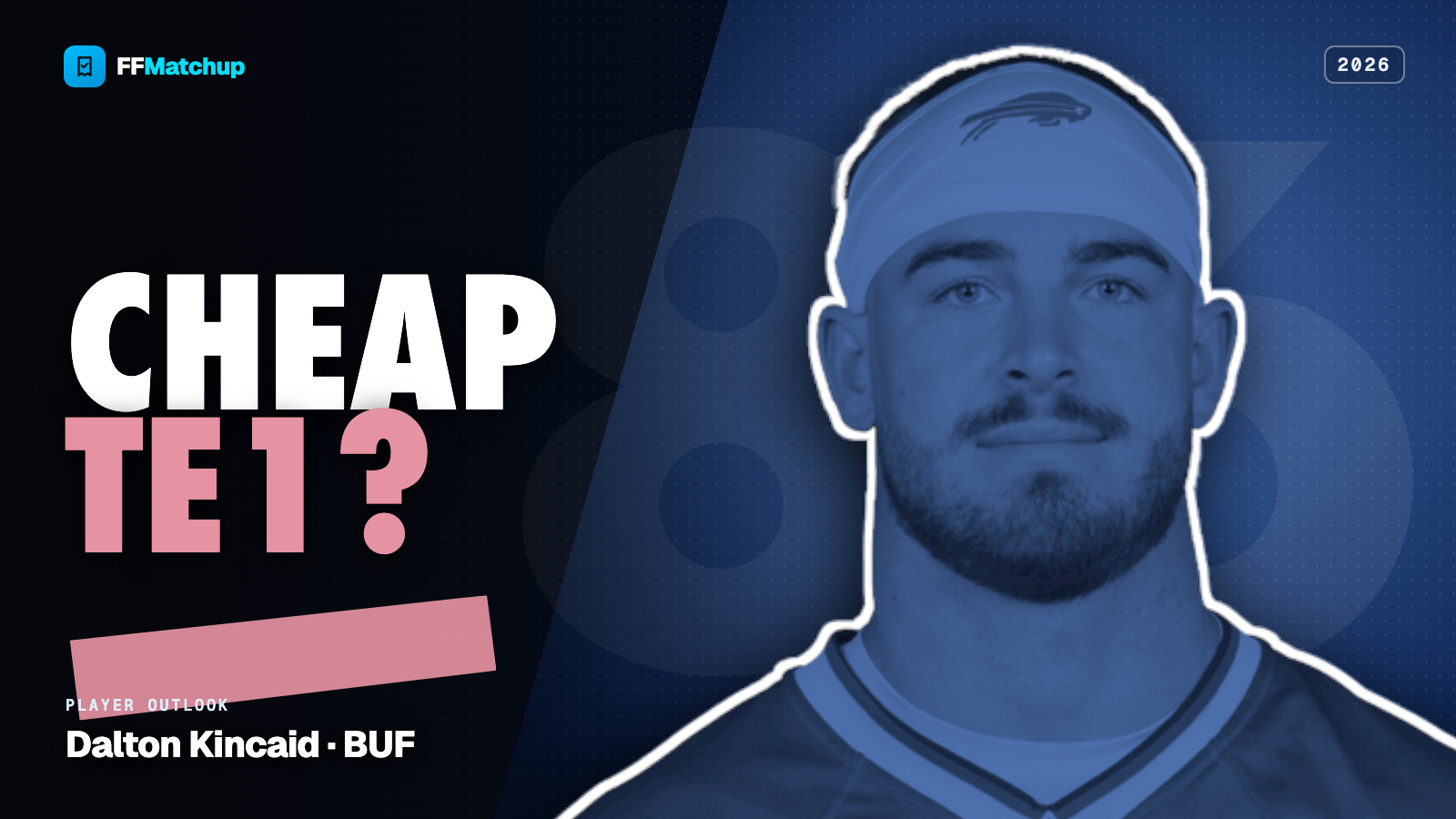
Dalton Kincaid Fantasy 2026: Is the Bills TE a Value at TE12?
Dalton Kincaid is priced like the last tight end you draft, a TE12 tag on an every-down athlete in a high-scoring Buffalo offense. The bull case is a target share with real room to grow. The bear case is the part the price already knows: a thin 49-target 2025, a boom-or-bust graded record, a snap count that was not every-down, and a red-zone role that belongs to the other Bills tight end.
Dalton Kincaid: fantasy points, matchups, and our calls


Dalton Kincaid enters his third year priced like an afterthought. He is going as the TE12, an overall PPR ADP of 115.6, roughly the last starting tight end off the board, after a 2025 that produced 49 targets, 39 catches, 571 yards and 5 touchdowns over 12 games, a 10.5 points-per-game line. For a former first-round tight end with every-down athletic tools in one of the league's best offenses, that is a bargain tag, and the bargain is the reason to look. But the same box score that makes him cheap also names the reasons, and the biggest one is who else is standing in the Buffalo red zone.
The bull case: a cheap, every-down profile with room to grow
The reason to buy is the gap between the price and the role. Kincaid is an athletic, move-tight-end who works the intermediate middle: a 9.49-yard average depth of target with 6.64 yards after the catch per reception, the kind of profile that scales fast if the target share climbs. At 49 targets in 12 games he was underused, not ineffective, and he plays in a Josh Allen offense that reliably produces fantasy points. If the snap count and the target share both grow in year three, a TE12 price on that role is where value lives, because you are paying a floor tag for a player whose ceiling is a weekly starter. That is the entire case, and at this cost it does not take much to clear the bar.
The bear case starts with the snap count
Here is what the price already knows. Kincaid played just 37% of the snaps across his 12 games, which is not an every-down role, and 49 targets is a thin base to build a fantasy season on. His graded record reflects the volatility: our start/sit calls on him cleared the line in only 11 of 25, a 44% mark, boom-or-bust rather than dependable. Buffalo also spreads the ball around by design. Slot receiver Khalil Shakir led the group with 95 targets, 72 catches and 719 yards working underneath, and Keon Coleman added a downfield element on 59 targets. Even James Cook pulls 40 targets out of the backfield. In an offense that distributes this evenly, a tight end needs either volume or scoring to matter, and the volume was not there in 2025.
The competitor check: the red-zone tight end is Dawson Knox, not Kincaid
This is the part a Kincaid buy has to reckon with. The high-value tight-end work in Buffalo, the red-zone and goal-line role that turns targets into touchdowns, ran through the OTHER tight end. Dawson Knox took 12 red-zone targets and 5 goal-line touches in 2025, against Kincaid's 7 red-zone targets and a single goal-line touch. That is the honest cap on Kincaid's scoring ceiling: even when Buffalo gets close, the tight-end look near the end zone has been Knox's. And sitting above both of them is Josh Allen, who is his own goal-line offense, taking 16 goal-line touches and 21 inside-the-10 touches on the ground in 2025. When the quarterback is the short-yardage back and the other tight end owns the red-zone targets, the touchdown equity that would lift a tight end's floor is the hardest thing for Kincaid to claim. Allen's throw profile (a 7.32-yard average depth of target, 11.3% deep rate) is friendly to an intermediate tight end, so the targets can come; the touchdowns are the contested part.
The receipts, and the price
Put it together and Kincaid is a cheap swing on growth, not a safe floor. The 44% graded record and the 37% snap share say the volatility is real and the role was not every-down. The 9.49-yard aDOT and the athletic profile say the talent to break out is there if the usage climbs. At a TE12, overall 115.6 price you are paying almost nothing for that swing, which is the right way to buy it: as your second tight end or a late dart in a one-tight-end league, not as a set-and-forget starter. If the snap count grows and the target share climbs toward the 90-plus Shakir commanded, there is a real TE1 season in the tools. If Buffalo keeps spreading it and Knox keeps the red-zone work, he is a boom-or-bust streamer. Every call and every result is on his player page, so you can watch the snap trend before you commit a starting spot.