Positional scarcity 2026: where to invest early and where to wait
Scarcity, not talent, should drive your first five picks. The tight end position falls off a cliff after two names. Wide receiver does not. Here is how to draft the difference.
Trey McBride: fantasy points, matchups, and our calls


The best draft edge is not picking the most talented player available. It is picking the player whose position runs out first. Talent tells you who is good. Scarcity tells you what a pick actually costs you, because every player you pass has a replacement, and the size of that replacement gap is the only thing that matters. In 2026, the scarcity map is unusually clear, and it points almost entirely at one position.
The tight end cliff is steep
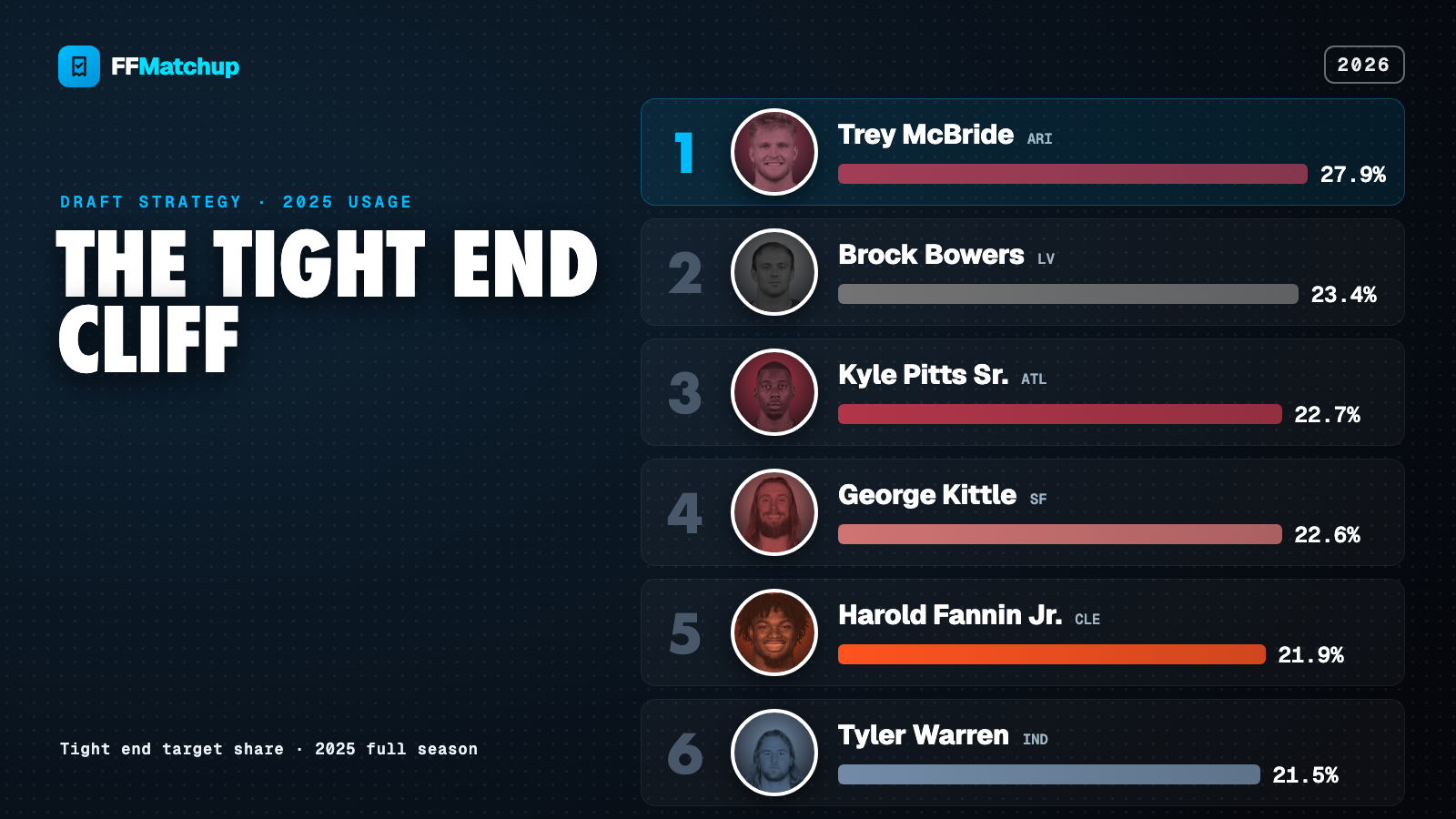
Look at where tight ends come off the board. Brock Bowers goes around pick 18 overall and Trey McBride around pick 21. Then the floor drops out. The third tight end, Colston Loveland, does not go until roughly pick 39, an eighteen-pick gap behind McBride. The fourth, Tyler Warren, falls to the mid-50s, and by the time you reach the eighth tight end, Sam LaPorta, you are into the mid-80s overall. That is not a slope. That is a cliff.
The usage data underneath confirms it is real and not just draft-room habit. In 2025, McBride commanded a 27.9 percent target share and Bowers 23.4 percent, both elite for the position. After them the position bunches: a wall of tight ends sit in the low 20s and high teens, separated by fractions of a percent. When the third-best option at a position is statistically interchangeable with the tenth-best, the two names above them are worth a real premium, because missing on both means starting a replacement-level tight end every single week for four months.
Wide receiver is the opposite
Now run the same test at receiver, and the picture inverts. Fourteen of the top twenty-four players on the board are wide receivers, and twenty-nine of the top sixty. The drop from the fifth receiver to the twentieth is gradual, not a cliff. You can wait a full round or two at receiver and still land a player with a genuine target share and downfield role, because the next comparable option is always a few picks away. Paying up for a receiver in the first two rounds is fine when the talent is elite, but reaching for a receiver purely out of scarcity fear is a mistake. The scarcity is not there.
How to draft the difference
This is the actionable part. If one of the two elite tight ends falls to you at a reasonable price, take him, because you are buying a weekly edge at a position where everyone else will be streaming. If both are gone, do not chase the tier that follows. Wait, and take a tight end from the interchangeable middle much later, using our target-share and red-zone data to pick the one with the clearest role rather than the biggest name. You lose almost nothing by waiting once the cliff has already happened.
At receiver, let the depth work for you. Because startable receivers keep falling, you can spend early capital on the scarce positions and backfill receiver in the middle rounds without your lineup suffering. Our value board is built to surface exactly these gaps between what a player produces and what the market charges, and our coverage and defense-versus-position data lets you exploit the depth week to week. Positional scarcity is the same logic that powers our lineup optimizer: a player is only as valuable as the drop-off to whoever replaces him.
The verdict
Do not draft the best player. Draft the biggest replacement gap. In 2026 that gap lives at tight end, where two names tower over a flat, interchangeable field, and it does not live at receiver, where the depth runs thirty deep. Pay up for scarcity, wait on abundance, and let our usage data pick the middle-round options the market is sleeping on.