Nico Collins vs Jayden Higgins: How Houston Splits Its Air Yards in 2026
Both Houston receivers run deep, but the offense does not point at them equally. Collins commanded a 33.3% air-yards share to Higgins's 18.3% in 2025. Here is what the split says about a set-and-forget alpha and a cheap second-year dart.
Houston runs two receivers who both like to work down the field, and that is exactly why the air-yards split is worth reading closely. Nico Collins and second-year Jayden Higgins posted nearly identical average depths of target in 2025, 12.7 yards for Collins and 12.3 for Higgins, so neither is a possession slot man padding a line on screens. The difference is not the route depth. It is the volume of the field the offense hands each of them. Collins commanded a 33.3% air-yards share. Higgins ran an 18.3% air-yards share. That gap is the whole story of why one is a set-and-forget alpha and the other is a cheap breakout dart.
Collins is the alpha, and the share proves it
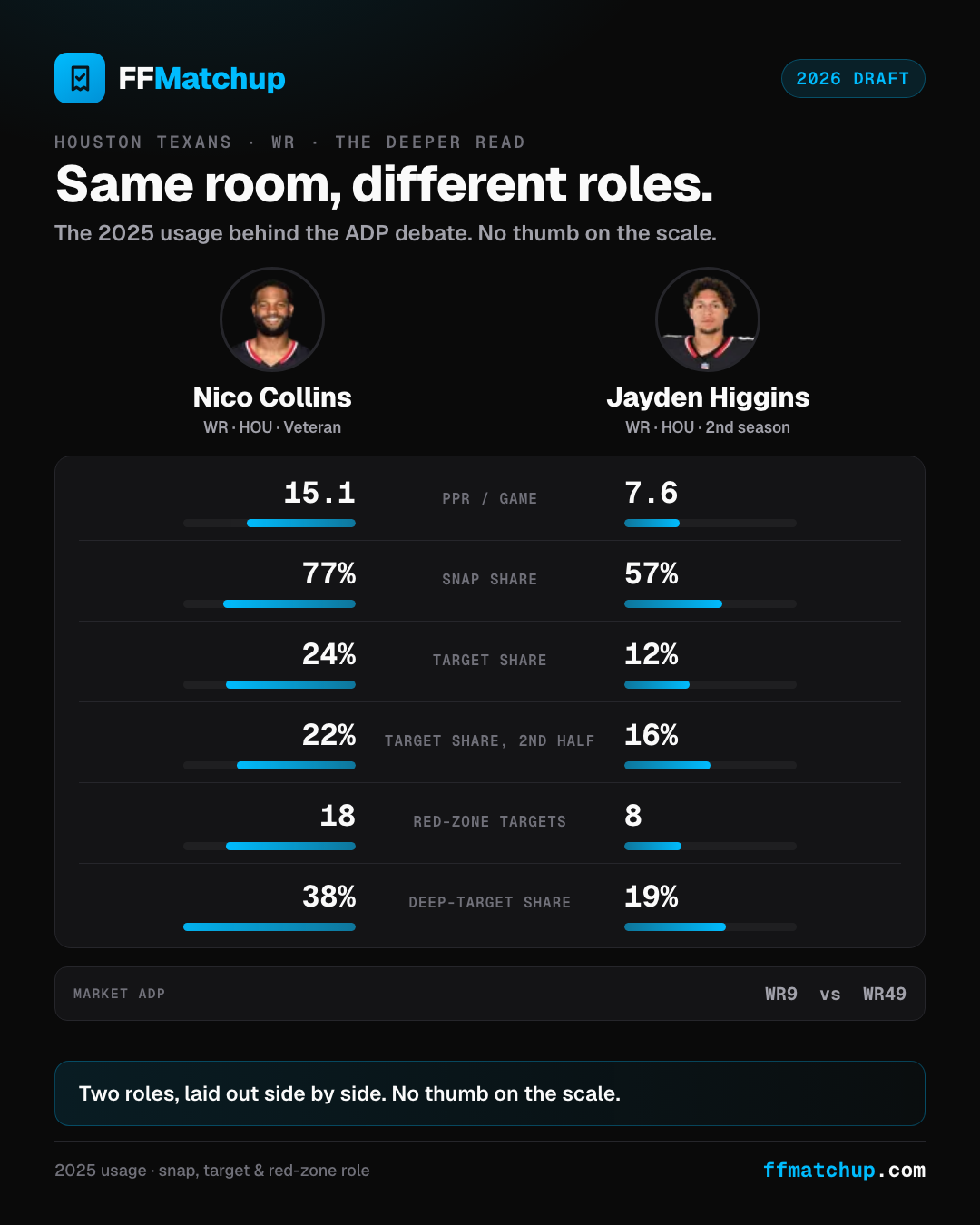
Collins is the receiver Houston points at when it needs a chunk. His 33.3% air-yards share on a 24.2% target share made him a genuine No. 1, and he backed the deep role with a real red-zone job: 18 red-zone targets and 7 goal-line touches in 2025. The production followed, 71 catches for 1,117 yards and 6 touchdowns on 120 targets across 15 games, good for 15.1 PPR points per game and a WR10 per-game finish. He is going as the 9th receiver off the board in 2026. That is a set-and-forget price for a set-and-forget role, and the air-yards share is the single number that says the alpha claim is not committee talk.
Higgins is the cheap dart, and the profile is why
Here is the part the box score hid. Higgins is the No. 2, but he is not a checkdown No. 2. He ran a 12.3-yard average depth of target, essentially as deep as Collins, and turned a 18.3% air-yards share on just 68 targets into 41 catches for 525 yards and 6 touchdowns over 17 games. Match the touchdown count: Higgins scored as many times as Collins on barely half the targets, the kind of efficiency a second-year receiver flashes before a role grows. He is going as the WR49, overall pick 122, which is a bench dart, not a starter. The bet is simple and cheap: if Houston's passing volume climbs, the receiver already running a deep 18.3% air-yards share is the one whose target count moves the most.
The third mouth, and what it means for both
The room is not just two men. Tight end Dalton Schultz ran a 14.3% air-yards share on 106 targets in 2025, a real target-earner who caps how high any single week can go for the receivers around him. That context cuts both ways. It is why Collins is the clear alpha rather than a target monopoly, and it is why Higgins's path to a breakout runs through more total passing volume rather than through simply stealing Collins's looks. There is one more wrinkle that points Higgins's way: Christian Kirk ran a 7.9% air-yards share on 52 targets across 13 games in Houston in 2025, and he has left for San Francisco in 2026. That is a real chunk of vacated volume that has to go somewhere, and the receiver already running a deep 18.3% air-yards share is the natural place for it to land. Tank Dell, by contrast, played zero games in 2025 while injured, so he is not baked into this split.
How to draft the two of them
These are not competing picks. Collins is a top-of-your-draft receiver you take for the floor and the role, and his WR9 price already reflects the alpha air-yards share. Higgins is a last-few-rounds swing you take because the deep aDOT and the touchdown efficiency are already there on a small sample, and the only missing ingredient is volume. Own Collins for what he is. Own Higgins for what the profile says he could become if Houston throws more. The split is the map: same room, same route tree, very different prices, and one clear reason why.