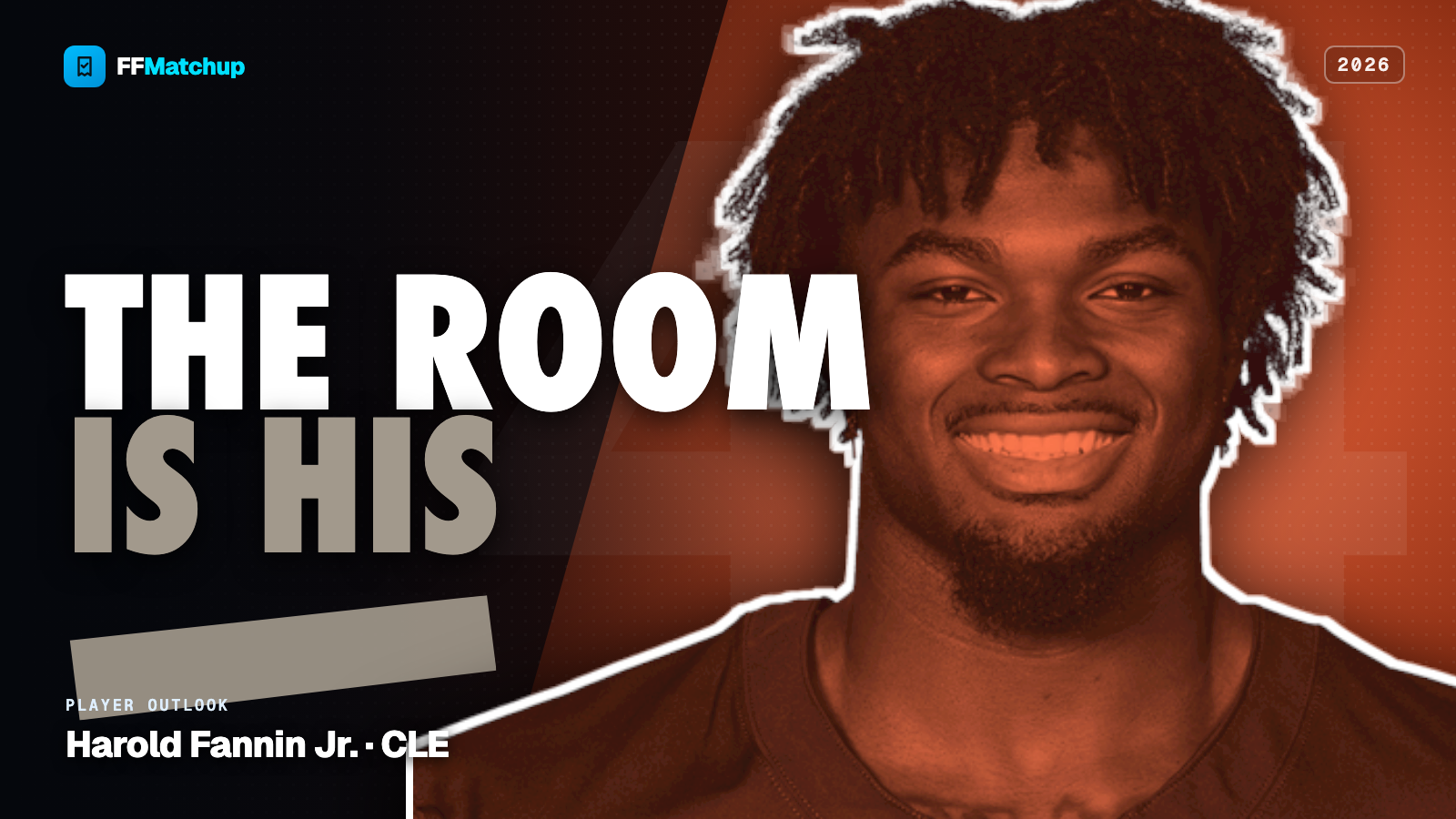
Harold Fannin Jr. Fantasy 2026: Is the Browns' Second-Year TE a TE5 Sleeper?
Fannin posted real rookie target volume and already out-worked the veteran ahead of him, and now David Njoku is gone and the Cleveland tight end room is his. The bull case is a target-earning young TE at a mid-round price. The honest caps are a possession role underneath a true air-yards alpha, a modest scoring line, and a rookie-led quarterback room that sets his ceiling.
Harold Fannin Jr.: fantasy points, matchups, and our calls


Harold Fannin Jr. is one of the more interesting tight end darts on the 2026 board, and the case starts with something rare for a rookie tight end: real target volume. In his first season he drew 107 targets and caught 72 of them for 731 yards and 6 touchdowns across 16 games, good for a 186.4 PPR total, about 11.7 points a game, on a 76 percent snap share. That is a legitimate role, not a spot-start novelty. The market has him going as the TE5, an overall PPR ADP of 76.0. At a position where most managers are choosing between waiting and paying up, a young tight end who already commanded a 21.9 percent target share is worth a real look.
The bull case: he already won the room, and now it is empty
The best part of the Fannin case is that he did not need a depth-chart change to earn his role, he earned it on the field. He out-targeted the incumbent David Njoku outright in 2025, 107 targets to 48, and Njoku has now signed with the Chargers. So the tight end target share that Fannin already led is not being contested by a returning veteran, it is fully vacated. A 32.6 percent share of Cleveland's tight end targets flowed through the position last year, and Fannin is the one left standing to absorb it. For a second-year player entering as the clear lead at his position, that is the setup you want: proven usage plus a cleared path.
The competitor check: the air belongs to Jeudy, not Fannin
Here is the honest half. Fannin is a volume-and-possession tight end, not a downfield weapon, and the Cleveland passing tree makes that plain. The air-yards alpha is Jerry Jeudy, who drew 106 targets for 602 yards on a 35.9 percent air-yards share, meaning the deep and intermediate shots run through him. Fannin worked underneath at a 6.04 aDOT on an 18 percent air-yards share, catching passes near the line and doing his damage after the catch. The backfield also eats into the checkdown targets he lives on: Dylan Sampson drew 40 targets as the passing-down back and lead runner Quinshon Judkins added 36. None of that erases Fannin's role, but it caps it. His path to a weekly TE1 line is volume and touchdowns, not a jump in yards per target.
The honest cap: a modest scoring line and a rookie-led quarterback room
Two things keep this in dart territory rather than a lock. First, the scoring: 6 touchdowns and a 6.04 aDOT describe a possession tight end whose ceiling depends on target volume holding, and his graded record from our past calls was a weak 14 at 36 percent, a small, unimpressive rookie sample that we are not selling as a signal. Second, and more important, the quarterback room is genuinely unsettled. Our data lists rookie Shedeur Sanders atop the depth chart, with Dillon Gabriel on injured reserve and Deshaun Watson still in the mix, so the man throwing Fannin his 107 targets is not a settled answer. A young tight end's floor is only as stable as his passer, and that is the single biggest swing factor here. Confirm the Week 1 starter from a fresh source before you reach.
What it means for his 2026 price
Fannin is a second-year tight end who already earned a lead role and just watched the veteran ahead of him leave town, available at a TE5 tag. The bull case is the target volume, the cleared room, and the youth. The honest caveats are that he works underneath a real air-yards alpha, his scoring line is modest, and his quarterback situation is a live question. That combination is exactly what a mid-round tight end swing should look like: a real role with a real ceiling if the volume and the passing game cooperate, at a price that does not demand they do. If you wait at tight end, he is a defensible target as the last starter you draft rather than the first.