Bye-week punt strategy 2026: when to sacrifice an early week for a better roster
Most managers ignore bye weeks until the Week 5 panic. The smart move is to plan the pain, punt one week on purpose, and never downgrade a pick just to dodge a bye.
Jahmyr Gibbs: fantasy points, matchups, and our calls


Bye weeks are the most predictable problem in fantasy football and the one managers plan for the least. You know every bye before you draft. You know exactly which weeks your roster will be thin. And yet most drafts treat byes as a surprise that arrives in Week 5, followed by a scramble on the waiver wire. The edge here is small but free: decide in August which week you are willing to lose, and build toward that instead of against it.
Plan the pain, do not spread it thin
There are two coherent bye strategies and one incoherent one. The incoherent one is drafting blind and ending up with your studs scattered across six different bye weeks, so you are quietly a starter short from Week 5 through Week 14 without ever noticing why your scores sag.
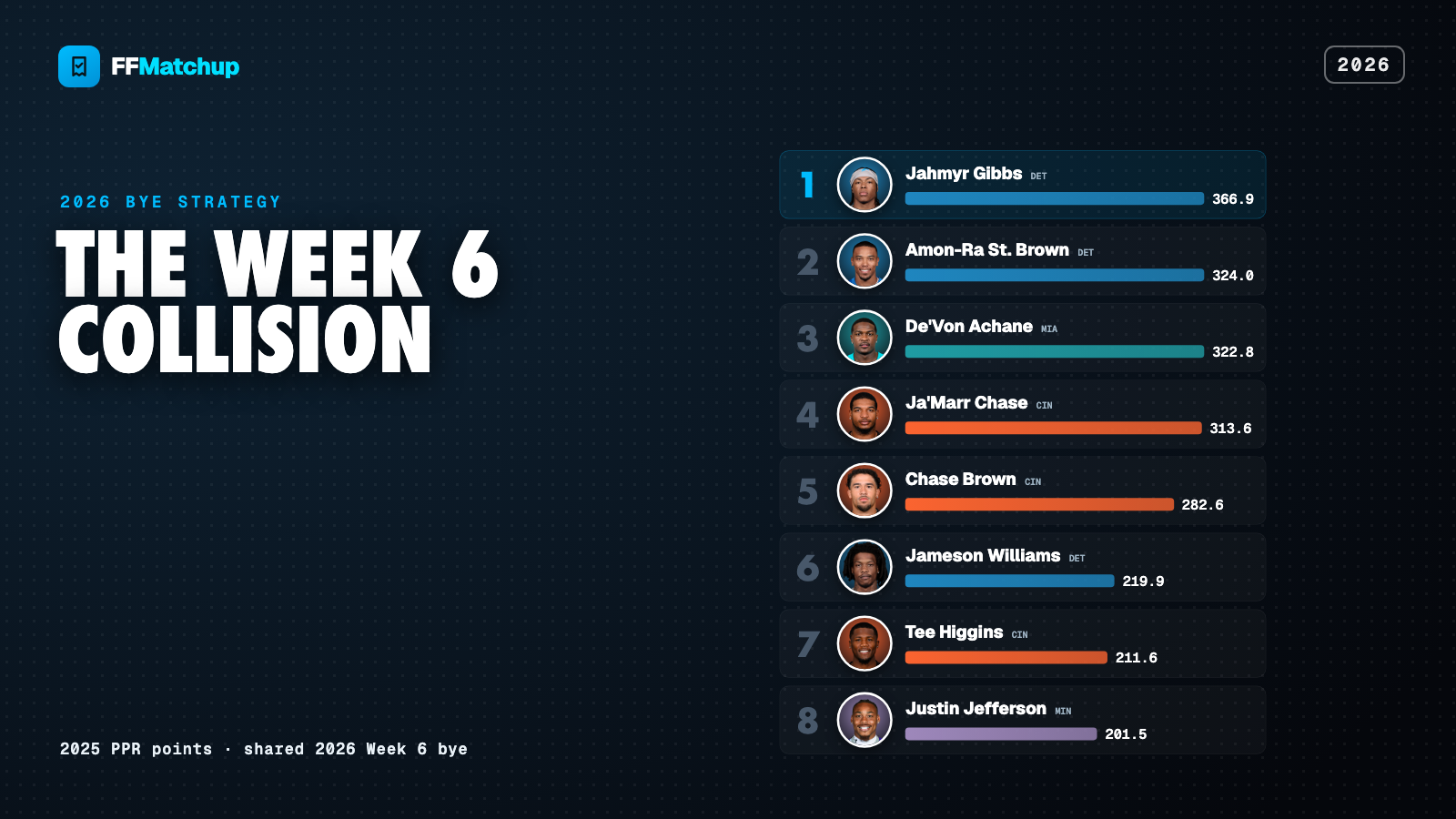
The two real options are concentrate or spread. Concentrating means deliberately clustering byes so you punt one week hard and stay whole the rest of the season. In 2026 that is very draftable, because the elite tiers already cluster. Nine of the top sixty players on our board (snapshot 2026-08-24) share the Week 6 bye, including Ja'Marr Chase, Amon-Ra St. Brown, Jahmyr Gibbs, De'Von Achane, and Justin Jefferson. Weeks 10 and 11 each carry ten top-sixty players, and Week 13 carries nine. If you already own two Week 6 studs, adding a third is not reckless. You are choosing to lose one week you can plan around, a week where you start your bench and your streamers, rather than bleeding two points off your projection for two months.
The scoring on a single bye week is not trivial, which is exactly why planning beats improvising. The eight skill players who share the 2026 Week 6 bye combined for a huge share of last season's production, led by Gibbs at 366.9 PPR points, St. Brown at 324.0, and Achane at 322.8. If three of those are on your roster and you did not see the collision coming, Week 6 is a loss. If you saw it and drafted a bench built to absorb it, Week 6 is a scheduled day off.
Never downgrade a pick to dodge a bye
Here is the hard rule that separates smart bye planning from superstition: the bye week is a tiebreaker, never a reason to draft a worse player. If two players are genuinely close on our value board and one conveniently fills a bye hole, take the convenient one. But passing a clearly better player because he shares a bye with your first-rounder costs you fourteen weeks of production to save yourself one. That trade never makes sense. Draft the better player and solve the one week later.
The early-season punt
The other side of this is the willingness to sacrifice Weeks 1 through 4 for a better roster overall. The fantasy title is decided in the playoffs, not in September. If a player with a genuinely higher ceiling comes with a slow ramp, a brutal opening schedule, or an early bye, that is a discount, not a disqualifier, in a season-long league. Use our defense-versus-position and coverage data to know which of your players face the toughest early matchups, lean on your depth for those specific weeks, and let the roster you actually want carry you into November. The managers who over-draft for Week 1 certainty tend to be the ones tinkering at the bottom of the standings by Week 12.
Byes are free information. Decide which week you will punt, cluster toward it on purpose, and build a bench that can eat that week without flinching. Never trade fourteen weeks of a better player for one convenient bye. And do not let a soft September talk you out of the stronger roster. Plan the pain in August and it stops being pain at all.