Nico Collins Fantasy 2026: Houston's Downfield Alpha Is a Second-Round Bet
Collins owned a 33.3% air-yards share and a 24.2% target share on a 12.7-yard average depth of target in 2025, the profile of a true No. 1. He is going as the 9th receiver off the board. Here is the alpha case and the honest reason the price is not a bargain.
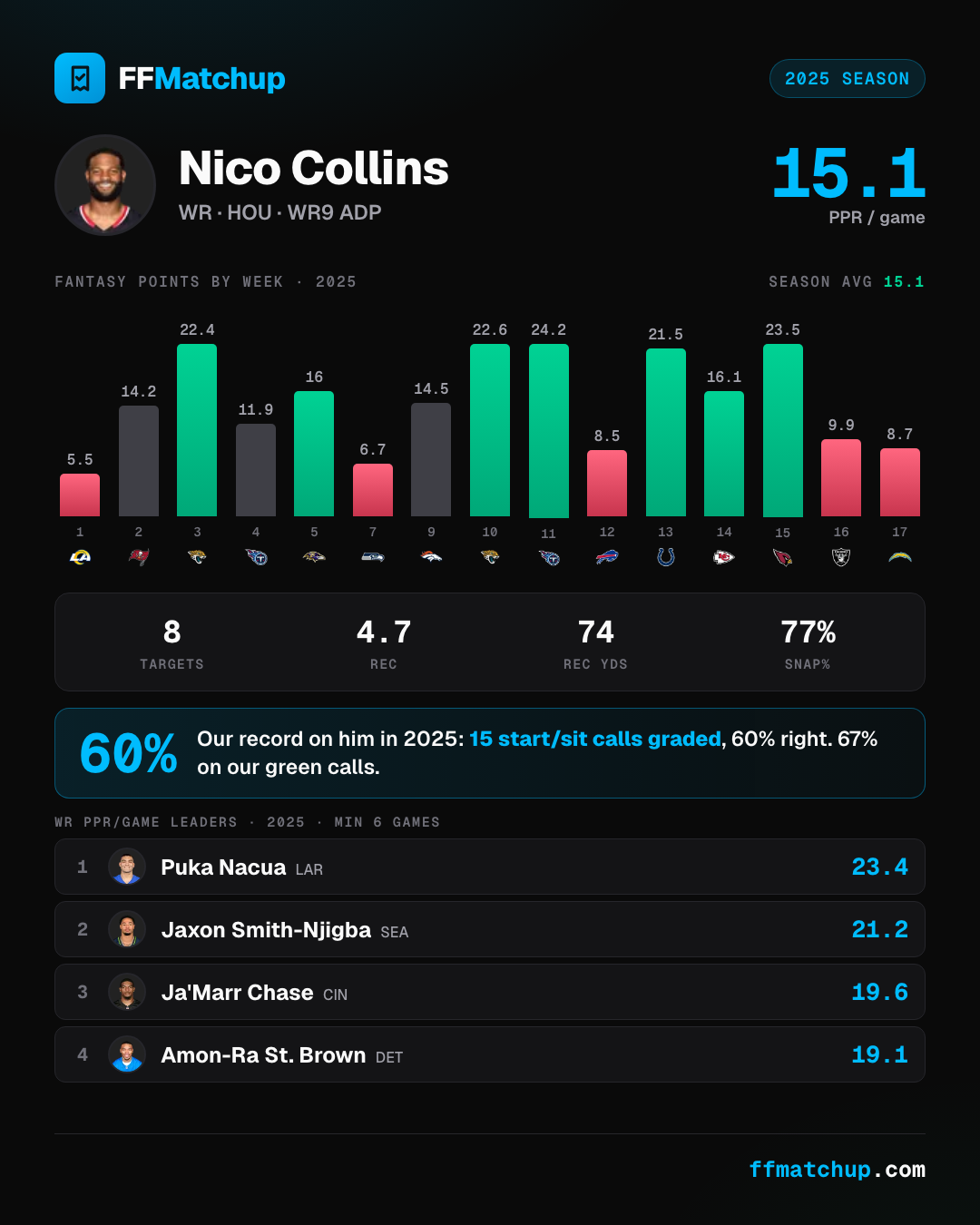
Nico Collins is the kind of receiver fantasy drafters want to own and the kind the market has learned to price up. In 2025 he was Houston's downfield alpha in the clearest sense: a 24.2% target share and a 33.3% air-yards share on a 12.7-yard average depth of target, which turned into 71 catches for 1,117 yards and 6 touchdowns on 120 targets across 15 games. That worked out to 15.1 PPR points per game, a WR10 per-game finish. He is going as the 9th receiver off the board in 2026, so the question is not whether the talent is real. It is whether an early-second-round pick is buying a bargain or paying full retail.
The usage is a genuine No. 1, and it is a downfield role
Collins does not win on volume of short throws. He wins deep. A 33.3% air-yards share paired with a 12.7-yard average depth of target means he is the first read and the field-stretcher, the receiver Houston points at when it needs a chunk play. He backs it with a real red-zone job: 18 red-zone targets and 7 goal-line touches in 2025. This is not a possession complement padding a stat line on screens. It is the profile of a receiver who carries the passing game, and he did it while missing two games.
The room: a clear alpha, but not the only mouth
The competitor check matters here, and it comes back in Collins's favor. His top target-earning teammates in 2025 were Jayden Higgins, the second-year receiver who drew a 18.3% air-yards share on 68 targets, and tight end Dalton Schultz, who ran a 14.3% air-yards share on 106 targets. Collins nearly doubles Higgins on air-yards share, which is exactly what you want to see under a claim of alpha: the downfield role is not committee. The nuance is that Schultz and Higgins are real target-earners who cap the ceiling on any given week, so Collins is the clear No. 1 rather than a target monopoly.
The receipts, week by week
Usage sets the range. Our graded calls test whether we read the individual weeks right, on the record. Collins cleared the line in 9 of 15 graded 2025 weeks, a modest 60%, with the ceiling on display: 24.2 points against Tennessee in Week 11, 23.5 against Arizona in Week 15, and 22.6 on 136 yards against Jacksonville in Week 10. Across his full two-year graded history we sit at 17 of 27 (63%). That 60% single-season number is the honest part of this profile. Collins is a high-floor talent whose weekly scoring still swings with a Houston offense that ran hot and cold, and a 6-touchdown season leaves obvious upside if the red-zone looks convert at a better rate. Every call and every result is on his player page.
What it means for his 2026 price
Collins is a bet on the role and a bet on the offense. The role is elite and not in doubt: a top-of-position air-yards share, a downfield aDOT, a red-zone job, and a clear separation from the No. 2. The caution is that a WR9 price already reflects all of that, so the value comes from Houston taking a step, not from the market missing the player. If the offense climbs and the touchdowns regress up from 6, the early-second pick looks smart. If Houston stays middling, you paid a top-10 price for a WR10 season. That is a fair bet, not a discount.