Mike Evans and Brock Purdy: The Fit Is the Question
San Francisco added a first-ballot resume. Talent was never the question. Depth is: across three seasons Mike Evans caught the ball five yards past where Brock Purdy throws it. The yardage fit is a real question, but the red-zone role travels to any offense.
Mike Evans: fantasy points, matchups, and our calls


San Francisco added a first-ballot resume in Mike Evans. A decade of 1,000-yard seasons, one of the great red-zone and contested-catch receivers of his era. None of that is the question. The question is narrower: does his game line up with how Brock Purdy actually plays quarterback? His 2025 was a six-game injury year, so we read him on his fuller 2023-2025 profile, the more honest sample.
Fantasy fits break on depth of target. A deep, contested-catch receiver needs a quarterback who pushes the ball downfield. Purdy is one of the most efficient passers in football, but he is not that quarterback, and the gap here is wide.
Where Purdy actually lives
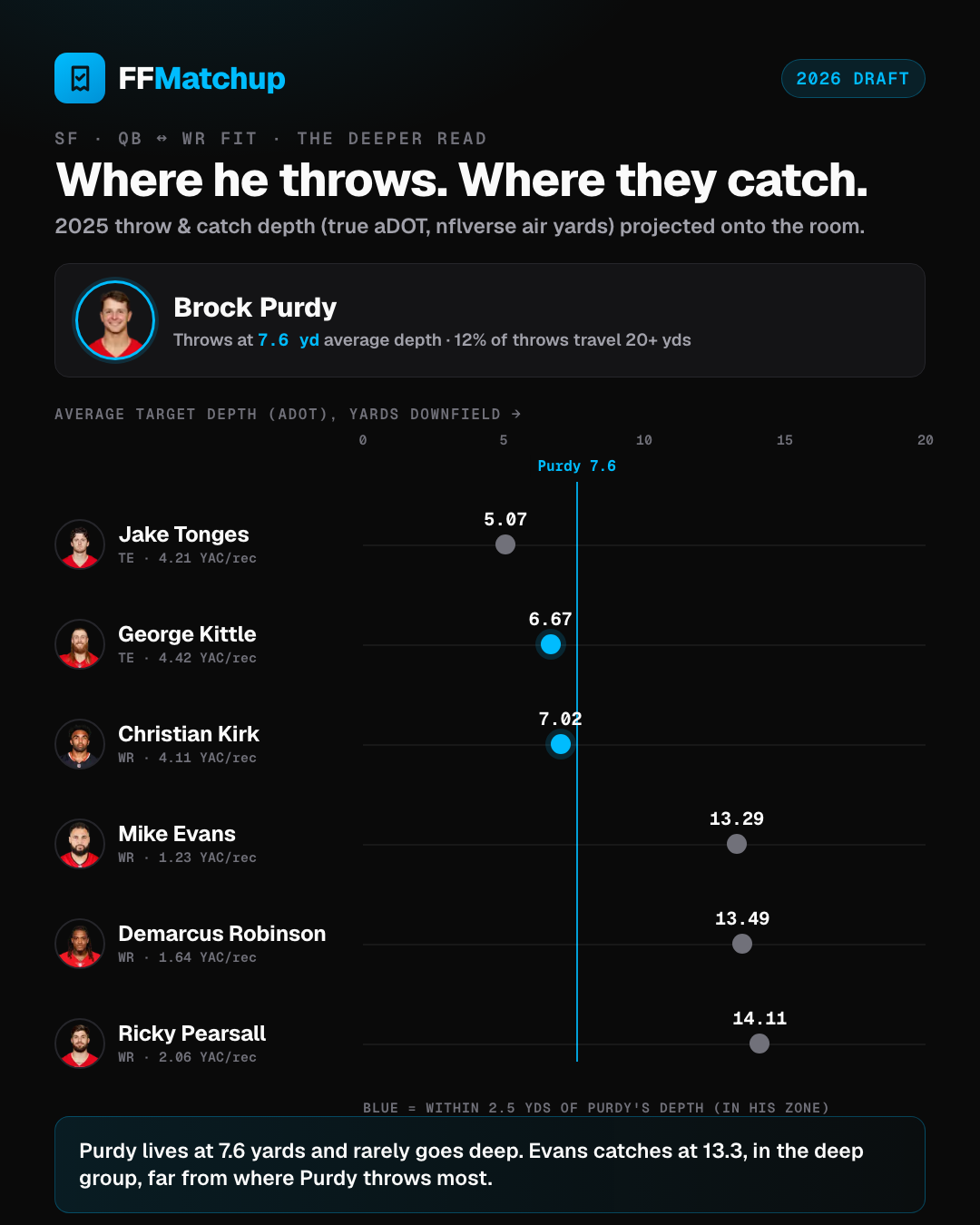
Across 284 attempts, Purdy's true average depth of target was 7.6 yards, and only 12% of his throws traveled 20-plus yards downfield. He wins with timing, play-action, and the yards his weapons create after the catch, not by hunting shots. The pass-catchers inside his comfort zone are George Kittle (6.67) and Christian Kirk (7.02), another new arrival this offseason, both underneath targets.
Where Evans wins
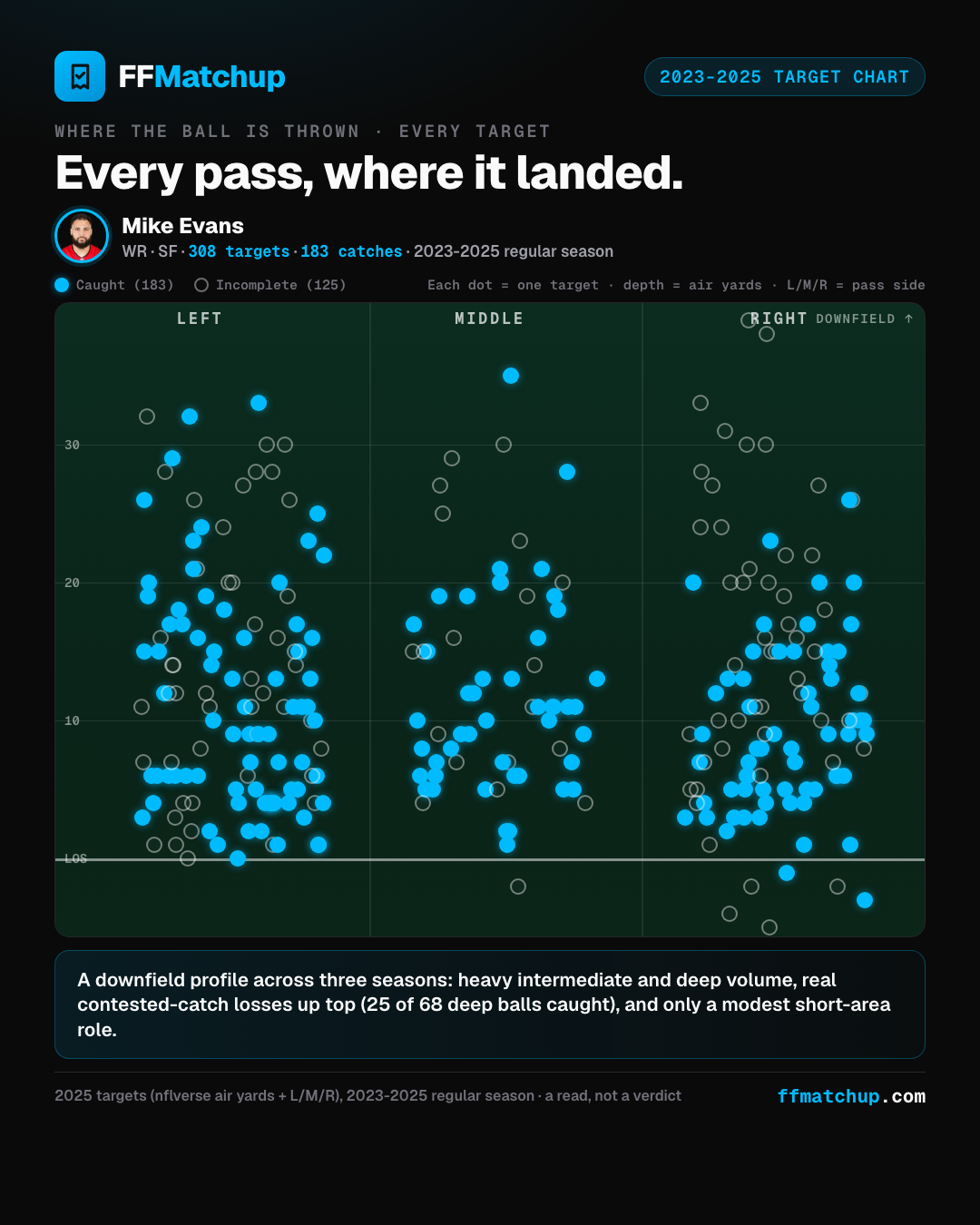
Evans is a downfield target, and consistently so: his catch aDOT was 13.0 yards over 2023-2025 (14.0, 11.6, and 13.3 by year), which puts him in San Francisco's deep group with Demarcus Robinson and Ricky Pearsall, well past Purdy's line. More than a fifth of his targets traveled 20-plus. This is a receiver who wins by getting open deep and boxing defenders out for contested balls.
The bridge is thinner than it looks
A depth gap does not automatically kill a fit. DJ Moore's pairing with Josh Allen survived it because Moore averaged 4.1 yards after the catch, so Buffalo could feed him short and let him create. Evans gives you some of that, but not much. He averaged 3.2 yards after the catch per reception over 2023-2025, below San Francisco's underneath weapons (Kittle and Kirk both above 4.0). He is a downfield winner, not a yards-after-catch creator, so feeding him short returns a possession target rather than the field-tilting weapon he has been.
The red-zone role that travels
Here is the value that does not depend on scheme. No matter the average depth, Evans scores. Over 2023-2025 he drew 40 red-zone targets, 18 of them at the goal line, and turned the role into 26 receiving touchdowns, roughly nine a year.
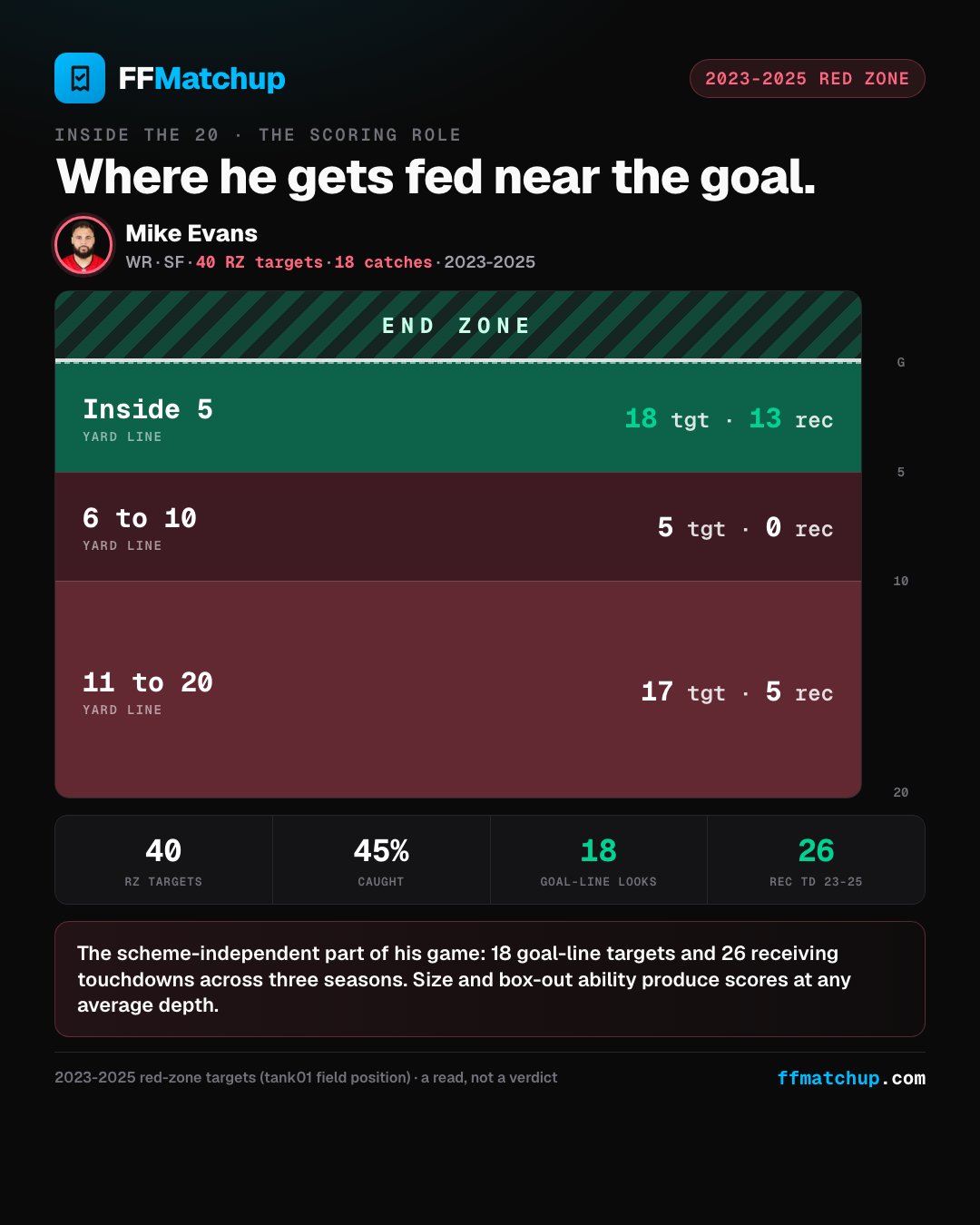
That goal-line role is the most portable part of his game. Even if Purdy's short passing shrinks Evans's yardage, his size and box-out ability keep producing scores. The touchdowns are the floor.