Kyren Williams Fantasy 2026: An RB15 Price on a Bellcow Who Finished RB11
Williams carried 259 times, scored 10 rushing touchdowns, and led the Rams' backfield at the goal line in 2025, then finished as the RB11. He is going as the 15th back off the board. Here is the case, and the honest reason the market holds the discount, Blake Corum included.
Kyren Williams: fantasy points, matchups, and our calls


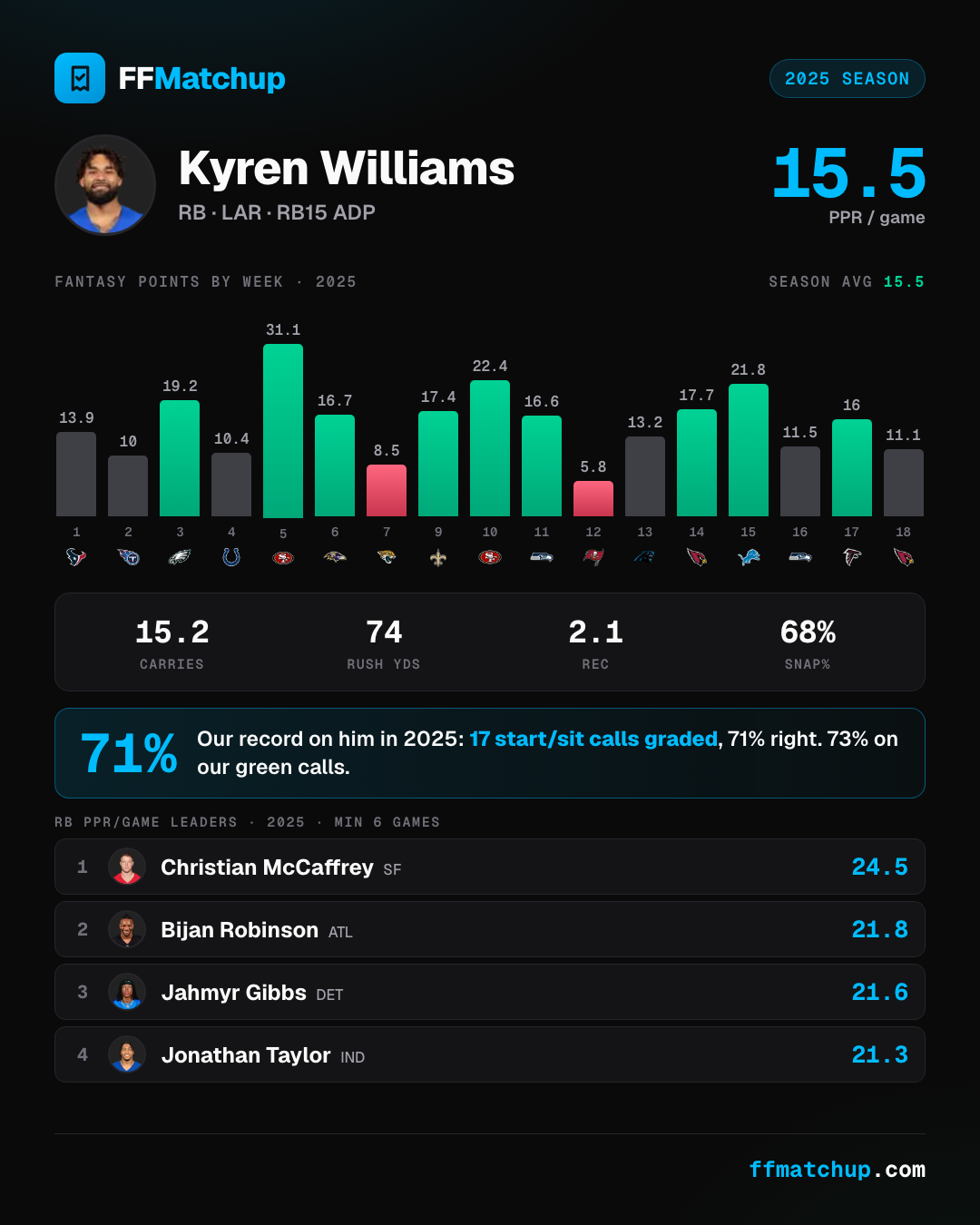
Kyren Williams is one of the least glamorous starting running backs in fantasy, and one of the most durable. In 2025 he played all 17 games, carried the ball 259 times for 1,252 yards and 10 rushing touchdowns, added 36 catches, and finished with 1,533 scrimmage yards and 13 total touchdowns. That came out to 15.5 PPR points per game, an RB11 finish. He is going as the 15th back off the board in 2026, which means the market is paying a mid-round price for a top-12 season. The question is whether the workload that produced it is real, and it is.
The volume is real, and he leads at the goal line
The case for Williams is not efficiency, it is ownership of the backfield. He handled 259 of the Rams' carries and, more importantly, the scoring touches: 63 red-zone touches, 33 of them inside the 10, and 18 at the goal line. That is the profile of a clear lead back in the part of the field where points get made. Goal-line work is the stickiest source of running back touchdowns, and it is the reason he reached 10 rushing scores. When you draft Williams you are buying the carries and the short-yardage role, and both held for a full 17-game season.
The honest caps: efficiency and passing work
Here is the two-sided part. The volume is elite, the per-touch profile is not. Williams averaged 4.83 yards per carry, a solid-not-special number, so his value is built on how many touches he gets rather than what he does with each one. He is also light in the passing game: a 8.1% target share on 50 targets means his PPR floor leans on the ground game. In a negative game script, where the Rams are trailing and passing, his workload can shrink, and that is the risk the RB15 price is quietly pricing. This is a floor play built on volume, not a big-play back.
The real risk behind him: Blake Corum
The other honest reason for the discount is the back behind him. Blake Corum is not a phantom handcuff. In 2025 he took 13 goal-line touches and scored 4 goal-line touchdowns of his own, so the Rams were already comfortable handing him the most valuable carries. Williams led that split, 18 goal-line touches to 13 and 8 goal-line scores to 4, but a lead in a committee is not sole ownership, and a healthy Corum is the one player who can chip into the short-yardage role that drives Williams's touchdowns. That is the risk quietly baked into the RB15 tag.
The receipts, week by week
Volume sets the range. Our graded calls test whether we read the individual weeks right, on the record. We called Williams startable in most of his 2025 weeks and he cleared the line in 12 of 17, including a 31.1-point game against San Francisco in Week 5, 21.8 against Detroit in Week 15, and 22.4 in the Week 10 rematch with the 49ers. Across his full two-year graded history we sit at 26 of 33 (78.8%). Every call and every result is on his player page.
What it means for his 2026 price
Williams is the rare back going below his production. He finished as the RB11 and is being drafted as the RB15, and the gap is the market discounting his modest efficiency and thin passing role rather than doubting the workload. If you believe the carries and the goal-line touches repeat, and a 17-game season says they can, you are getting a locked-in starter a round after his finish. Draft him as an every-week RB2 with the volume of an RB1, and accept that the ceiling is capped by the profile.