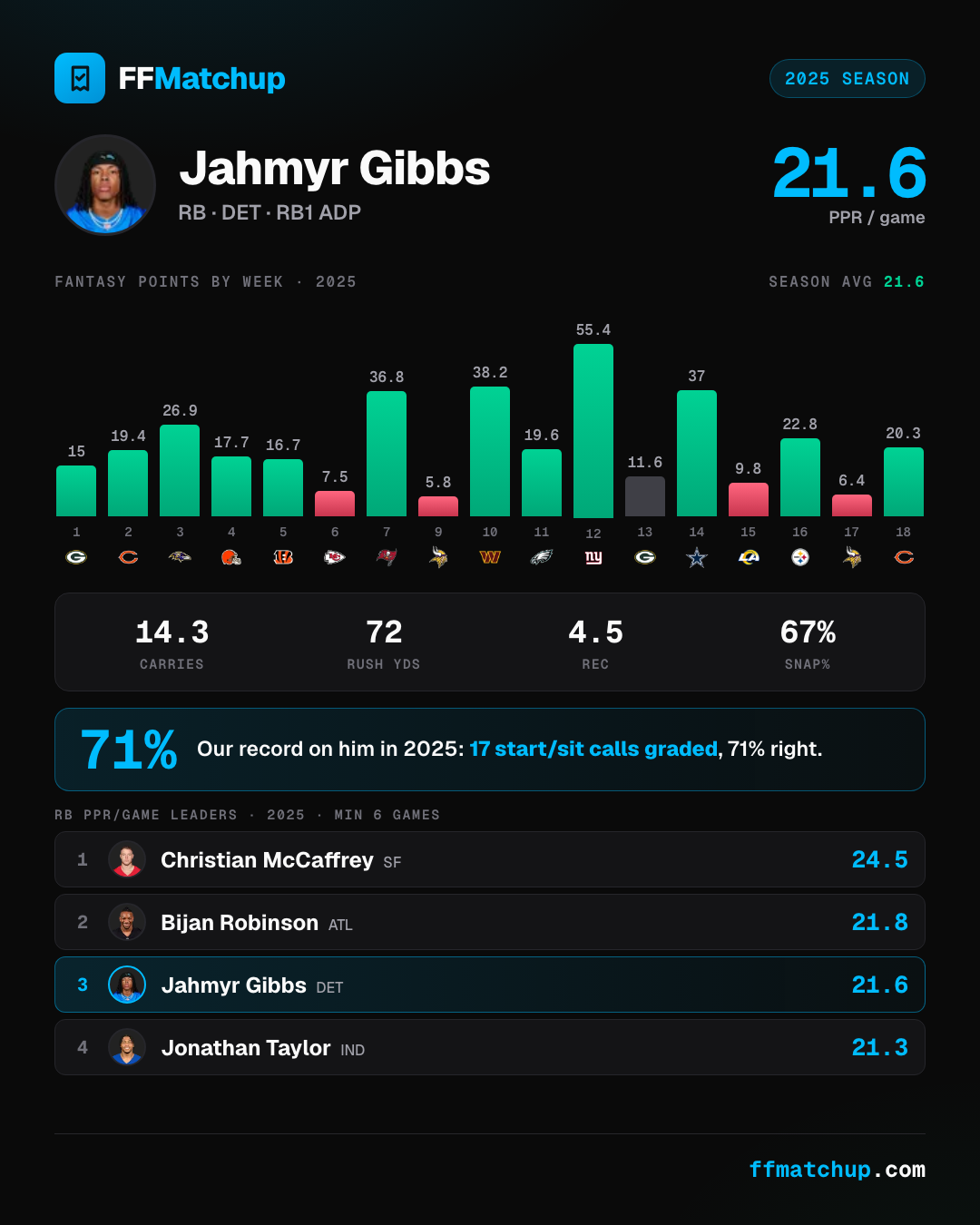
Jahmyr Gibbs 2026 Outlook: Why the Committee Does Not Matter
Gibbs is a top-three fantasy pick who shares his own backfield. That scares people every August. The usage says it should not: his fantasy value is built on the touches a committee cannot take away.
Jahmyr Gibbs: fantasy points, matchups, and our calls


Every August the same worry attaches to Jahmyr Gibbs: he does not get the whole backfield. David Montgomery is still there, still taking early-down and short-yardage work. So how does a running back in a timeshare cost a top-three overall pick, going at RB1 with an ADP of 3.3? The answer is in which touches Gibbs gets, not how many the other guy takes.
A committee caps a runner who only runs. It barely touches a back who catches passes and plays on third down. Gibbs does both at a level a timeshare cannot reach, so we pulled his 2025 usage apart to show what the split actually protects, and where it genuinely bites.
The pass-game role is recession-proof
The touches that vanish in a committee are the early-down carries in a game you are losing. The touches that do not are targets. Gibbs ran a 22.8% third-down target share and drew 94 targets on the season, turning them into 77 receptions. That is a receiving role most wide receivers would take, and it does not depend on game script. When Detroit trails, Gibbs stays on the field as a receiver. That is the floor a timeshare cannot repossess.
The goal line is a real committee, and it still pencils out
Here is the honest bear case, because a committee back has one, and it is at the goal line. Gibbs does not own it. He took 12 goal-line touches and 26 inside-the-10 touches in 2025, but David Montgomery took 14 goal-line touches and 21 inside-the-10 touches of his own, ran 31 red-zone carries, and punched in 8 rushing scores on 158 carries. Detroit genuinely splits the short-yardage work, so some of Gibbs' touchdown equity is Montgomery's to take, and anyone selling Gibbs as the goal-line back is skipping that. What keeps the read intact is everything around the stripe: Gibbs still out-carried Montgomery inside the 20 (51 red-zone carries to 31), owns the passing-down role outright, and finished with 13 rushing and 5 receiving touchdowns anyway. The goal line is shared. The volume and the receiving work that feed the rest of the scoring are not. That is how 366 points survived the committee, and it is why the floor does too.
Our record says the profile is trustworthy
We grade our start/sit calls in public, misses included. On Gibbs in 2025, the season on the card above, we graded 17 calls and hit 12 of them (71%), every one a green (start) call. Widen it to both seasons we have tracked him and the record is 82% across 34 calls, with 78% on our green calls and a clean sweep on our lean-toward calls. We were rarely wrong to trust him, which is the point: an elite, stable, week-winning profile is exactly the kind our model reads well, and the kind a draft pick should feel boring, in the best way.