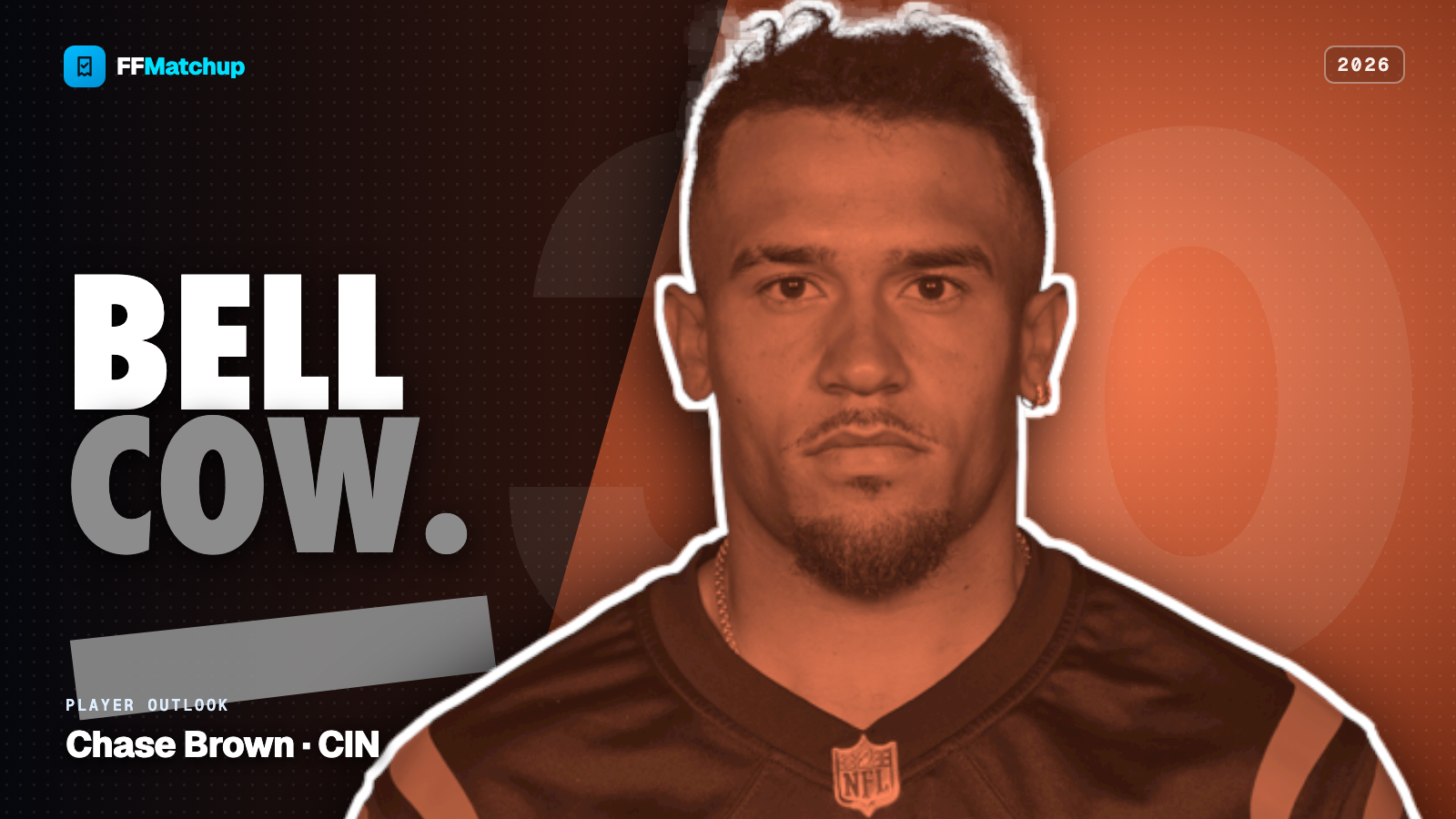
Chase Brown Fantasy 2026: A 300-Touch Bellcow Finally Priced Like One
Brown handled roughly 300 touches, owned the Cincinnati goal line, and finished as the RB7 in 2025. He is now going as the 6th back off the board, a slot ahead of where he finished. Here is the case that the workload is real, and the honest reason it is not a discount.
Chase Brown: fantasy points, matchups, and our calls


Chase Brown spent the first part of his career as a change-of-pace back and the whole of 2025 as a workhorse. He played all 17 games and did a bit of everything: 232 carries for 1,019 yards and 6 rushing touchdowns, plus 69 catches for 437 yards and 5 receiving scores. That is roughly 301 touches and 11 total touchdowns, and it added up to 16.6 PPR points per game, an RB7 finish. Here is the part that separates him from a lot of high-volume backs: he was also the goal-line back and a genuine receiving threat, so the workload is not a mirage of empty carries. He is going as the 6th back off the board in 2026, a slot ahead of where he actually finished, so the market is no longer giving him away.
The role is two-way, and the goal line is his
The case for Brown is that he owns the two parts of a backfield that matter most for fantasy: the goal line and the passing downs. He handled 15 goal-line touches, 24 inside the 10, and 47 red-zone touches in 2025, which is why he reached 11 total scores. He also caught 69 passes, so his PPR floor does not depend on a positive game script the way a two-down back's does. Add a 66.6% snap share and a 14.3% target share and you have a back who is on the field when the game is being decided. When you draft Brown you are buying real short-yardage equity and real receiving work, and both held for a full 17-game season.
The honest caps: a shared committee and a quarterback question
Here is the two-sided part. Brown leads the backfield, but he does not have it to himself. Samaje Perine is still in Cincinnati and still handles change-of-pace and passing-down snaps, taking 84 carries and 17 catches in 2025 and mixing in short-yardage looks (4 goal-line touches, 16 red-zone carries). Brown out-touched him at the goal line by a wide margin, so this is a complement and not a true committee, but Perine caps how high Brown's reception and carry counts can climb. The bigger swing is the offense itself: much of Brown's 2025 volume came with Joe Burrow limited, and a healthy Cincinnati passing game could mean fewer clock-killing carries even as it lifts the scoring. That is the honest tension the RB6 price is pricing.
The receipts, week by week
Volume sets the range. Our graded calls test whether we read the individual weeks right, on the record. We called Brown startable in most of his 2025 weeks and he cleared the line in 14 of 17, including a 32.9-point game against Miami in Week 16 that we graded a lean, a 29.1-point Week 17 against Arizona we had locked, and a 25.5-point surprise against the Jets in Week 8 we flagged as a toss-up. Across his full two-year graded history we sit at 27 of 33 (81.8%). Every call and every result is on his player page.
What it means for his 2026 price
Brown is not a value in the buy-low sense, and pretending otherwise would be dishonest. He finished as the RB7 and is being drafted as the RB6, a slot ahead of his finish, so the market has fully caught up to the breakout. What you are buying at that price is certainty: a three-down role, the goal-line touches, and a full 17-game season already on the record, rather than a projection. If Burrow is healthy the scoring environment rises around him, and if the run-lean script returns the volume does. Draft him as a locked-in RB1 whose range is defined by the offense around him, not by a battle for touches.