Trey McBride Fantasy 2026: The Tight End Who Earns a Wide Receiver's Workload
McBride ran a 91% snap share and led every tight end in target share and in our Opportunity Score in 2025. At a TE1 price, you are buying the position's clearest weekly floor. Here is the usage case, with the receipts.
Trey McBride: fantasy points, matchups, and our calls


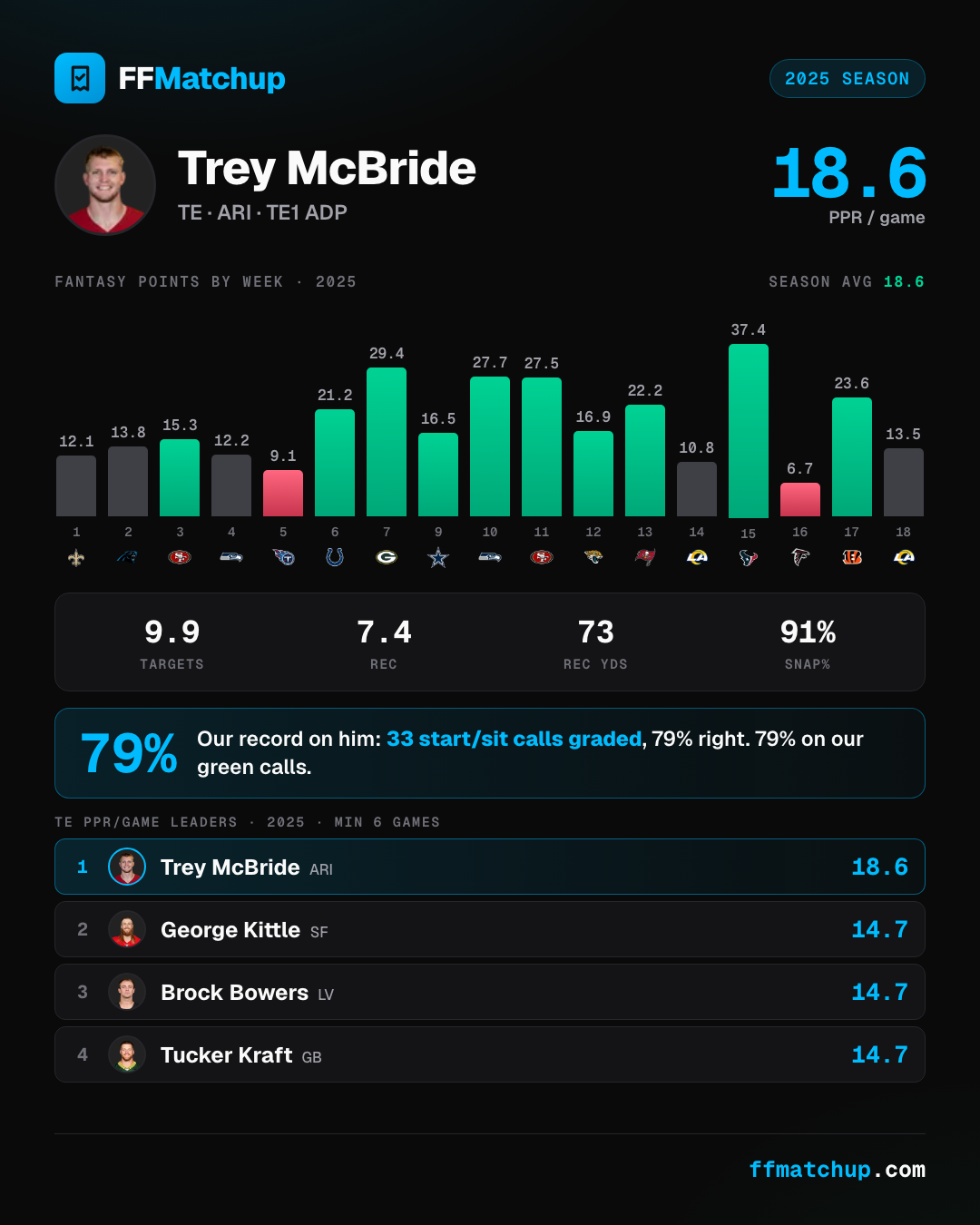
The knock on drafting a tight end early is that the position is a coin flip week to week. Trey McBride is the exception, and 2025 is why. He caught 126 passes for 1,239 yards and 11 touchdowns on his way to 18.6 PPR points per game across 17 games. Those are wide-receiver counting stats from a tight end, and they came from a wide receiver's workload.
McBride ran a 91.4% snap share and led every tight end in the league in target share at 27.9% and in our Opportunity Score at 0.704. He was not a matchup-week tight end. He was Arizona's primary passing-game option, on the field for essentially every snap, and the target share proves it.
The scoring role, not just the volume
Target volume gives a tight end a floor. The red-zone role gives him the ceiling. McBride finished second among all tight ends in red-zone target share at 36.7% (behind only Brock Bowers at 39%). That is the part of the workload that turns into touchdowns, and it is why the 11 scores were not a fluke of variance but a product of where he was used. He caught the ball at a 6.66-yard average depth of target with a 25.3% share of Arizona's air yards, the classic high-volume, work-the-middle tight end profile.
The receipts, week by week
Usage is the case. The graded calls are the proof we read it right. On McBride in 2025 we hit on 14 of 17 weeks, including 14 of 17 on our confident GREEN calls, and the ceiling weeks were real: 37.4 points against Houston in Week 15, 29.4 versus Green Bay in Week 7, 27.7 against Seattle in Week 10. Across every week we have tracked, his graded hit rate sits at 78.8%. The full call log is on his player page.
What the target competition changes, and what it does not
The one fair question for 2026 is target competition. Marvin Harrison Jr. is developing into Arizona's downfield No. 1, and Michael Wilson is an established target earner in his own right, 126 targets and 1,006 yards in 2025, so the competition is real. But McBride's value does not live downfield, it lives in the middle and in the red zone, where his 27.9% target share and 36.7% red-zone target share are structural, not situational. A tight end who plays 91% of snaps and works the areas the outside receivers do not is insulated from exactly that kind of competition. At a TE1 ADP, you are paying the position's top price for the position's safest workload.