Tee Higgins Fantasy 2026: Is the Bengals WR2 Worth a WR18 Price?
Tee Higgins scored 11 touchdowns as the nominal second receiver in Cincinnati and is going as a WR18 for 2026. The bull case is the red-zone role and a healthy Joe Burrow returning. The honest cap is a games-missed history, a boom-or-bust graded record, and a target hierarchy that runs through Ja'Marr Chase first.
Tee Higgins: fantasy points, matchups, and our calls


Tee Higgins is listed as the second receiver in Cincinnati, but he scored like a first one. Over 15 games in 2025 he turned 98 targets into 59 catches for 846 yards and 11 touchdowns, a 14.1 points-per-game finish built on one of the most valuable roles in fantasy football: the red-zone target magnet next to a true alpha. The market prices him as a WR18, an overall PPR ADP of 34.5. The touchdown production was real, and the role that generated it is intact, but the two things that make Higgins a WR2 price rather than a WR1 one are worth stating plainly.
The red-zone role is what you are buying
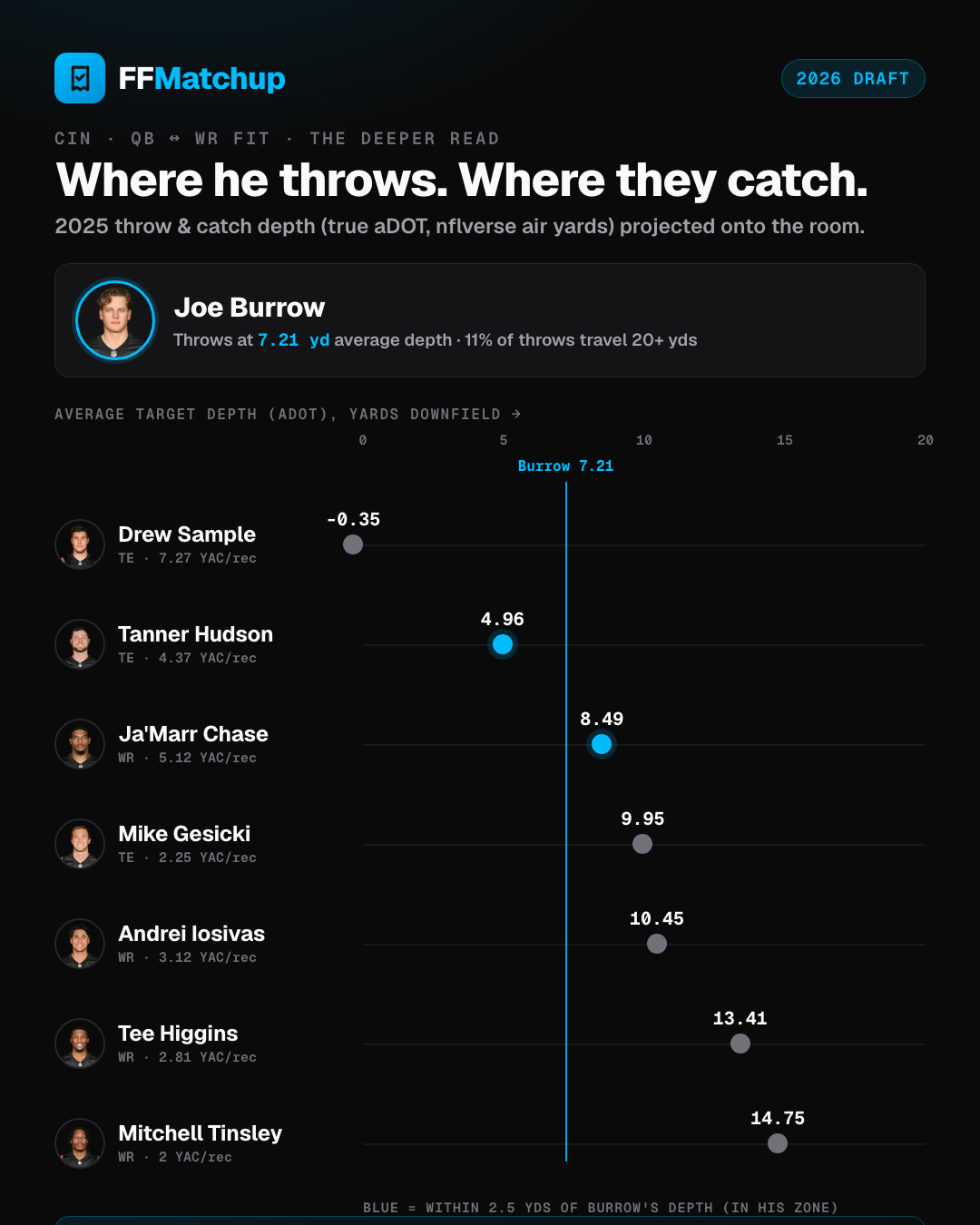
Higgins is not a volume alpha and the price does not ask him to be. What he is, is a big-bodied target who lives where points are scored. He drew 15 red-zone targets and 4 goal-line touches in 2025, and he works down the field: his 13.41-yard average depth of target was the deepest meaningful role in the Cincinnati passing game, and he still commanded a 28.8% air-yards share as the nominal second option. That combination, a downfield target who also finishes in the red zone, is why an 11-touchdown season is not a fluke that needs everything to break right. It is the natural output of the role.
The catch: Ja'Marr Chase is the target alpha, not Higgins
Here is the honest hierarchy. Ja'Marr Chase is the engine of this offense and it is not close. Chase drew 185 targets for 125 catches, 1,412 yards, and 8 touchdowns across 16 games in 2025, on a 34.4% air-yards share that led the team. Higgins is the finisher; Chase is the volume. That order matters for a WR18 price, because it caps Higgins's raw target ceiling: when the offense funnels a third of its air yards to Chase, Higgins's fantasy value leans on touchdowns and efficient downfield work rather than on a weekly 10-target floor. The chart shows the split cleanly. Chase works the underneath and intermediate areas at high volume while Higgins stretches the field and finishes in the red zone.
A healthy Joe Burrow is the swing factor
The bull case has a name, and it is the quarterback. Joe Burrow played just 8 games in 2025 before his season was cut short, which means a chunk of Higgins's 11 touchdowns came with a backup under center. A full, healthy Burrow season is the single biggest thing that can push Higgins from a touchdown-dependent WR2 toward a weekly starter. Burrow throws to a 7.21-yard average depth with a 10.8% deep-ball rate, an accurate, rhythm-based profile that feeds a red-zone target like Higgins on a steady schedule. The risk cuts the other way too: Higgins's ceiling is tied to Burrow's availability, and the 2025 season is a reminder that a quarterback injury reshapes everything downstream.
The receipts say role-with-a-caveat
The graded record keeps the framing honest. Our start/sit calls on Higgins cleared the line in 15 of 27, a 56% two-season hit rate, with the volatility you would expect from a touchdown-reliant profile: the boom weeks are real (a 33-point Week 9, a 27-point Week 14), and so are the quiet six-point afternoons when the touchdown does not come. Pair that with a games-missed history, 15 of a possible 17 games in 2025, and the read is a high-ceiling WR2 who wins weeks rather than a set-and-forget every-week WR1. Every one of those calls is graded on his player page.