Baker Mayfield and Emeka Egbuka: Tampa Bay's High-Correlation Fantasy Stack for 2026
Emeka Egbuka led all of Tampa Bay in air-yards share as a rookie, and the quarterback feeding him throws it down the field. When a passer's aDOT and his top receiver's aDOT line up, their fantasy weeks rise and fall together, which is exactly what a stack is built to capture. The honest caps are a weak graded record and a target tree that gets more crowded when the veterans are healthy.
Emeka Egbuka: fantasy points, matchups, and our calls


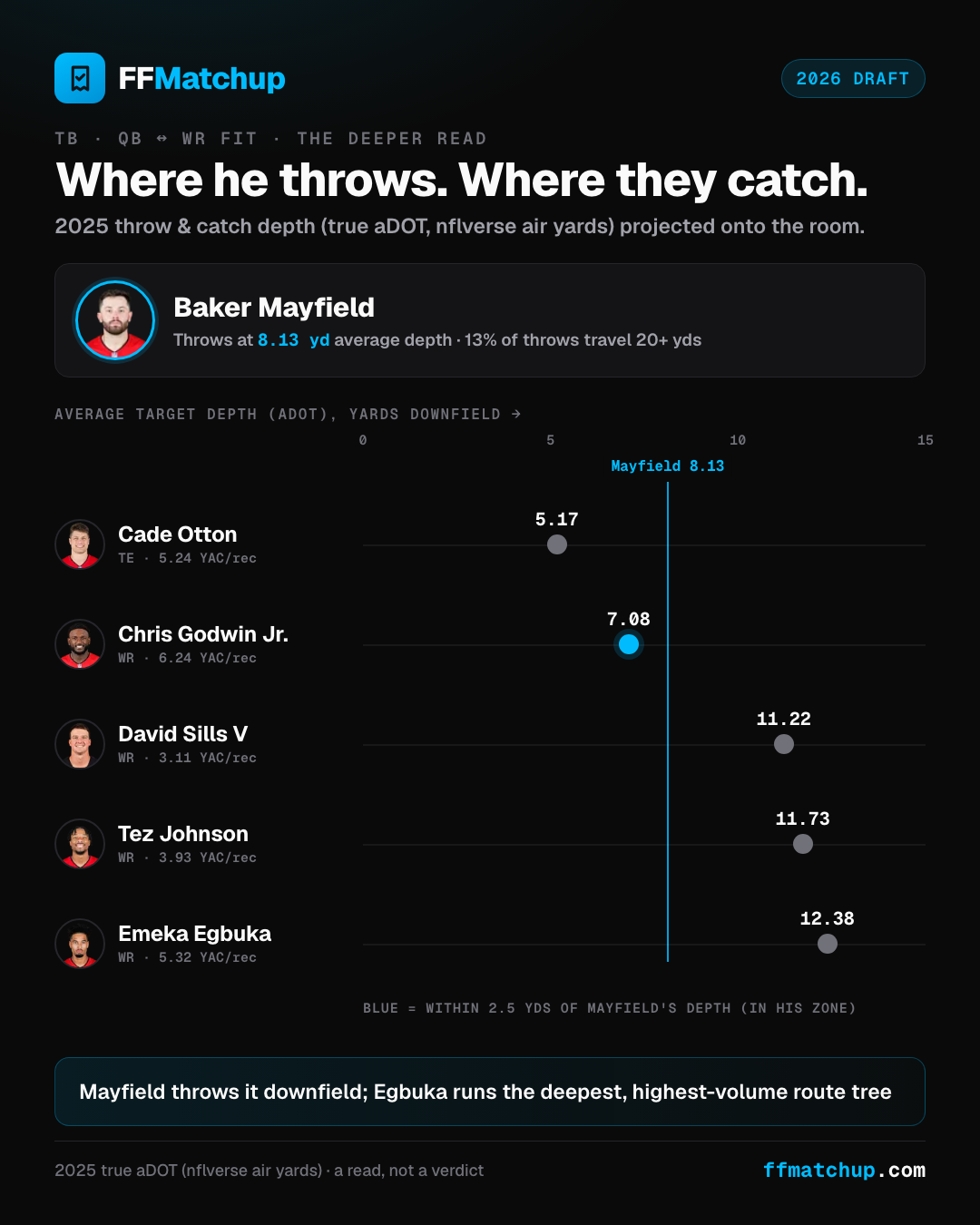
A stack works when two players' fantasy weeks move together, and the cleanest way to find one is to line up a quarterback's average throw depth with his top receiver's average catch depth. In Tampa Bay that line is short. Baker Mayfield threw at an 8.13-yard average depth of target with a 12.7% deep rate in 2025, an above-average downfield profile, and the receiver who ran the deepest, highest-volume route tree on the team was rookie Emeka Egbuka, who commanded a team-high 36.3% of the air yards on a 12.38-yard aDOT. When the passer wants to push it down the field and his best target lives down the field, their big weeks tend to arrive on the same Sunday. That is the stack, and Egbuka is going as the WR21, an overall PPR ADP of 39.0.
Egbuka ran the offense as a rookie
Start with the receiver, because he is the reason the stack exists. Egbuka played all 17 games and posted 127 targets, 63 catches, 938 yards and 6 touchdowns, an 11.5 points-per-game line on 77.7% of the snaps. The number that stands out is the air-yards share: 36.3%, the highest on the team, which means Tampa Bay's most valuable passing work, the downfield throws, ran through a first-year player. He backed the volume with red-zone involvement (14 red-zone targets, two goal-line touches) and a 12.38-yard aDOT that keeps him on the intermediate and deep routes rather than the checkdown tree. For a receiver at a WR21 price, that is a genuine every-week role, not a projection.
The quarterback throws to the same depth Egbuka catches
Now the correlation. Mayfield threw at an 8.13-yard average depth of target with a 12.7% deep rate, one of the more downfield quarterback profiles in the league, and Egbuka caught the ball at a 12.38-yard aDOT. That alignment is the point of a stack: when Mayfield has a big day pushing it down the field, the receiver running the deep, high-air-yards routes is the one who benefits, so their ceiling weeks correlate instead of cancelling out. The supporting chart plots Mayfield's throw depth against every Tampa Bay pass-catcher's catch depth, and Egbuka sits out past the reference line as the offense's downfield engine. You are not hoping the volume finds him. The 36.3% air-yards share says it already does, and the quarterback's profile says the deep work is there to be had.
The competitor check: the tree gets more crowded when the veterans are healthy
Here is the honest cap, and it is a real one. Egbuka's 36.3% air-yards share was earned in a season where Tampa Bay's veteran pass-catchers missed significant time. Chris Godwin, the established slot presence, played just 9 games in 2025 (51 targets, 33 catches, 360 yards) at a shallow 7.08-yard aDOT, and he profiles as an underneath, possession complement rather than a downfield rival, so a healthy Godwin competes for volume without directly contesting Egbuka's deep tree. The larger question is total mouths to feed: a full, healthy Tampa Bay receiver room is more crowded than the one Egbuka dominated as a rookie, and his 36.3% share is the most likely single number to regress if the veterans are on the field for 17 games. The bet is that the role he carved out, the downfield alpha, sticks even as the target count gets shared. That is a bet on the profile, not a guarantee on the volume.
The receipts and the price
Two honest caveats close it out. First, our graded start/sit calls on Egbuka landed at just 5 of 15, a 33% record, a weak mark on a small rookie sample, so this is a role-and-fit thesis, not a piece propped up by our track record on him. Second, the WR21 price is no longer a discount: at an overall PPR ADP of 39.0 the market has already priced in the rookie breakout, so you are paying for the role rather than stealing it. What the stack adds is correlation. If you roster Mayfield or play daily lineups, pairing the downfield passer with the receiver who owns the downfield tree turns two separate bets into one that compounds. The bull case is a proven 36.3% air-yards role and a quarterback who throws to it. The bear case is a weak graded record, a crowded room when everyone is healthy, and a price that already reflects the upside. Every call and every result is on both player pages.