Brock Bowers Fantasy 2026: A 23% Target Share Is a Tight End Playing Like a WR1
Bowers commanded a 23.4% target share on 86% of the snaps in 2025 and finished as the TE3 in just 12 games. He is the second tight end off the board. Here is what the usage says, and the honest reason the price is not a discount.
Brock Bowers: fantasy points, matchups, and our calls


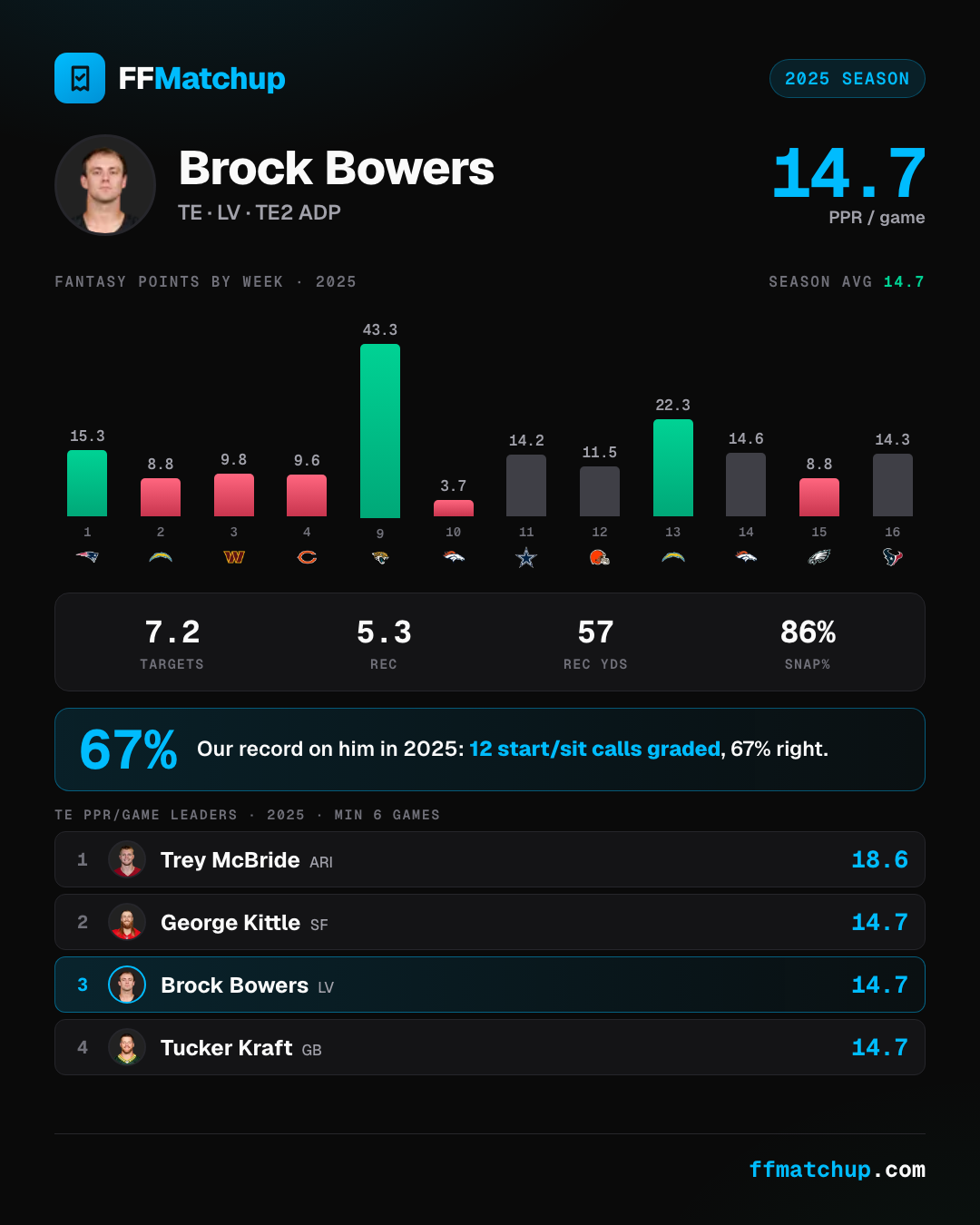
Brock Bowers does something tight ends almost never do: he plays like a number-one receiver. In the 12 games he suited up for in 2025 he caught 64 of 86 targets for 680 yards and 7 touchdowns, good for 14.7 PPR points per game and a TE3 finish. The number that separates him is the involvement: a 23.4% target share on 85.9% of the snaps. That is a receiver's workload from the tight end spot, and it is why he is the second tight end off the board in 2026.
The usage is what makes the position worth paying up for
Tight end scoring is scarce, so the edge comes from finding the few who are used like receivers. Bowers is one of them. His 23.4% target share would look at home on a team's top wideout, and he pairs it with the short-yardage role that produces touchdowns: 16 red-zone targets and 9 looks inside the 10. He is not a two-way or blocking-first tight end who spikes on schemed touches. He is the focal point of the passing game, and that is the version of the position that wins you a weekly positional advantage.
The ceiling is real, and it showed up
When a tight end sees that many targets, the ceiling games look like a receiver's. Bowers put up a 43.3-point game against Jacksonville in Week 9 and a 22.3-point outing against the Chargers in Week 13. Those are the weeks that win matchups outright at a position where most starters are hoping for 8 to 10 points. The usage is what makes them possible: volume plus a red-zone role is the recipe for tight end spike weeks, and he has both.
The honest caps: a possession profile and a 12-game sample
Here is the two-sided part, because this is a premium price. Bowers is a possession target, not a downfield one: his 6.51-yard average depth of target and 17.5% air-yards share mean the volume comes on shorter throws, so the yardage relies on his 4.77 yards after the catch per reception rather than big plays. And the 2025 sample is 12 games, not a full season, so the per-game rate is elite but the body of work is smaller than a receiver you would draft at the same cost. He is going as a top-20 overall pick, which means you are paying for the usage at full value, not buying a discount.
The quarterback fit works in his favor
The man throwing him the ball reinforces both sides of that. Kirk Cousins, the Raiders' expected starter, is a short, rhythm-based passer: a 7.03-yard average depth of target and a low 9.4% deep-throw rate. That underneath, high-volume profile is close to ideal for a possession tight end who wins on target volume, and it supports the floor that makes Bowers a set-and-forget starter. The flip side is the cap already noted: a quarterback who rarely pushes the ball downfield keeps Bowers's yardage tied to his 4.77 yards after the catch rather than downfield chunk plays.
The receipts, week by week
Usage sets the range. Our graded calls test whether we read the individual weeks right, on the record. We called Bowers startable across his 2025 games and he cleared the line in 8 of 12, including that Week 9 ceiling game against Jacksonville. Across his full two-year graded history we sit at 17 of 27 (63%), a reminder that even an elite-usage tight end has volatile weeks. Every call and every result is on his player page.
What it means for his 2026 price
Bowers is the cleanest bet at a scarce position: a tight end with a receiver's target share, a red-zone role, and a proven 40-point ceiling. The price is honest, a top-20 overall pick and the second tight end off the board, so you are not stealing value, you are securing a weekly edge at the hardest position to fill. Draft him as your tight end and start him every week, with the possession profile and the 12-game sample as the caveats you accept, not surprises.