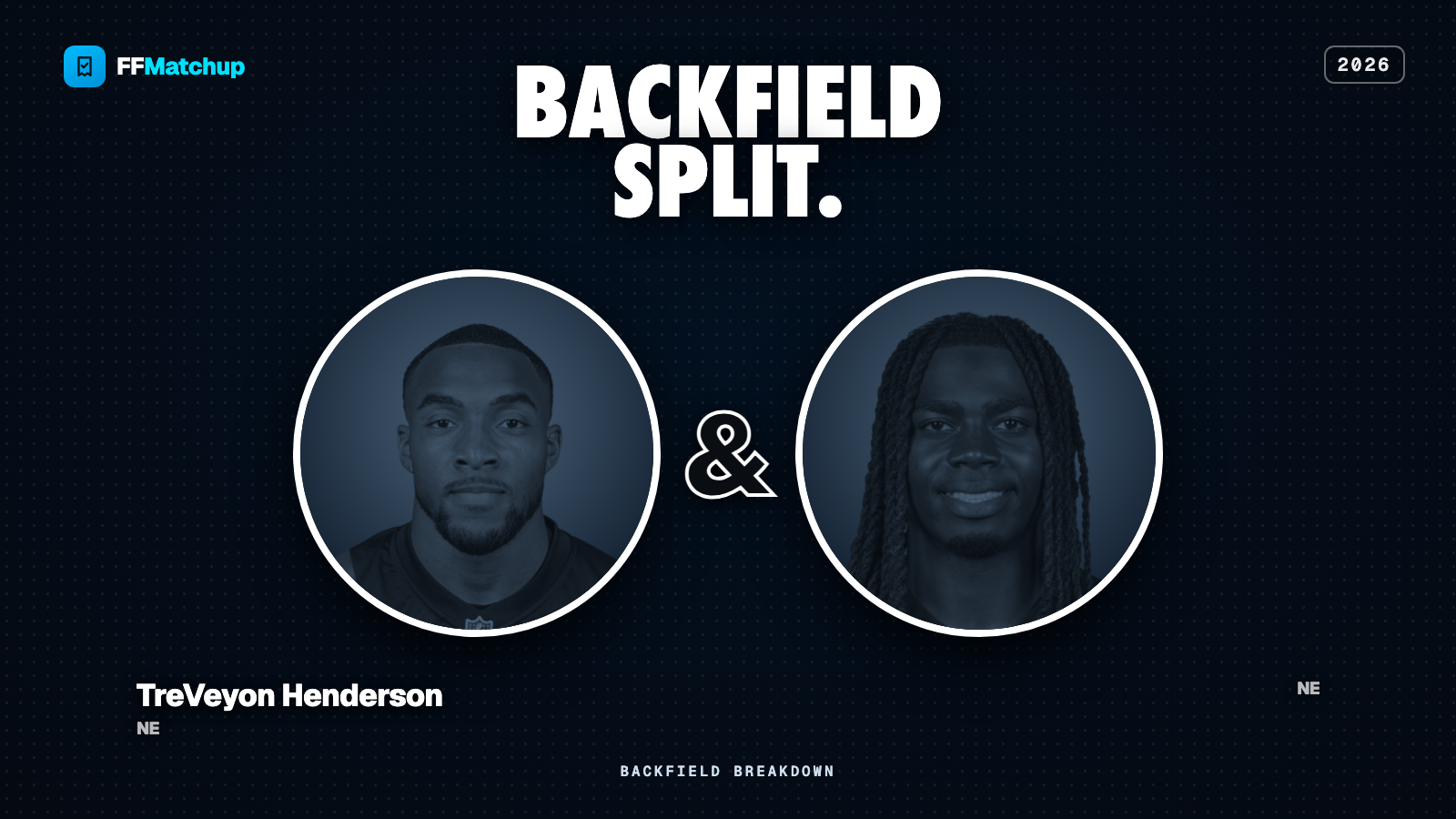
Patriots Backfield Fantasy 2026: TreVeyon Henderson or Rhamondre Stevenson?
New England's backfield is a genuine two-man committee, not a bell cow. The rookie has the bigger workload and the explosive carries. The veteran has the higher snap share and a shade more goal-line work. Both are drafted a round apart, and the tie-breaker is a coaching staff whose usage our data cannot project.
TreVeyon Henderson: fantasy points, matchups, and our calls


The New England backfield is one of the more honest committee questions on the 2026 board, and the draft market treats it like one: TreVeyon Henderson goes as the RB25 (overall PPR ADP 67.9) and Rhamondre Stevenson as the RB28 (overall PPR ADP 80.0), roughly a round apart. Both put up nearly identical fantasy production in 2025, both are healthy, and neither cleared the other for the workhorse role. This is not a bell cow with a handcuff. It is a two-man split where the tie-breaker is a coaching staff whose plans our data cannot see yet.
The rookie has the bigger workload
Henderson ran the larger share of the ground game as a rookie: 180 carries for 911 yards and 9 rushing touchdowns over 17 games, adding 42 targets and 35 catches, for 206.2 PPR points, 12.1 per game. He also carried the explosive and goal-line workload you would want from a lead back, 35 red-zone carries, 23 inside-the-10 touches and 9 goal-line touches. The catch is his snap rate: Henderson played just 46 percent of the snaps, which tells you he was the early-down and burst runner rather than a true every-down back. Big workload, big-play role, but not the full-time snap count that locks in a weekly floor.
The veteran keeps the every-down role
Stevenson is the mirror image, and this is the competitor check that makes the piece. He ran fewer times, 130 carries for 603 yards and 7 rushing touchdowns over 14 games, with 37 targets and 32 catches, for 178.8 PPR points, 12.8 per game, a virtually identical per-game output to the rookie. What Stevenson held is the trust: a 59 percent snap share, higher than Henderson's, and 10 goal-line touches to the rookie's 9, a shade more of the work that actually scores. The full New England running back room confirms the two-man split, the next back, Antonio Gibson, has left in free agency, and no other Patriot logged meaningful 2025 carries, so this is genuinely Henderson and Stevenson dividing one backfield.
The quarterback vultures the goal line too
There is a third mouth at the goal line, and it is the passer. Drake Maye is a running quarterback: he gained 450 rushing yards and took 21 red-zone carries, 14 inside-the-10 touches and 3 goal-line touches himself in 2025. That is real touchdown equity pulled out of the backfield before either running back gets a chance, and it caps the rushing-score ceiling for both. It is also why neither back projects as a lock for double-digit touchdowns: the goal-line pie is split three ways, not two. A mobile quarterback is a tailwind for an offense's efficiency and a headwind for its running backs' scoring, and New England has one.
What it means for your draft
Treat this as a committee, because that is what the data shows. Henderson is the higher-upside pick, more carries, more explosive work, and the younger legs, at the cost of a snap share that says the passing-down and closing role is not guaranteed. Stevenson is the safer role, more snaps and a shade more goal-line work, at a lower ceiling and a round-later price. Neither owns this backfield, and with Drake Maye vulturing goal-line carries, neither is a clean bet for a big touchdown total. The honest read is that whoever the new staff trusts on third down and at the goal line becomes the RB2-with-upside, and that decision is a known unknown we are not going to fake. Draft the rookie if you want the ceiling, the veteran if you want the snaps, and do not pay either one like a workhorse.