Ja'Marr Chase Fantasy 2026: A 32% Target Share Is the WR1 Floor, Whatever the Bengals Do
Chase commanded a 32.1% target share and a 34.4% share of Cincinnati's air yards in 2025. That volume, not the win total, is what sets his 2026 price. Here is the case, and the one number that can still climb.
Ja'Marr Chase: fantasy points, matchups, and our calls


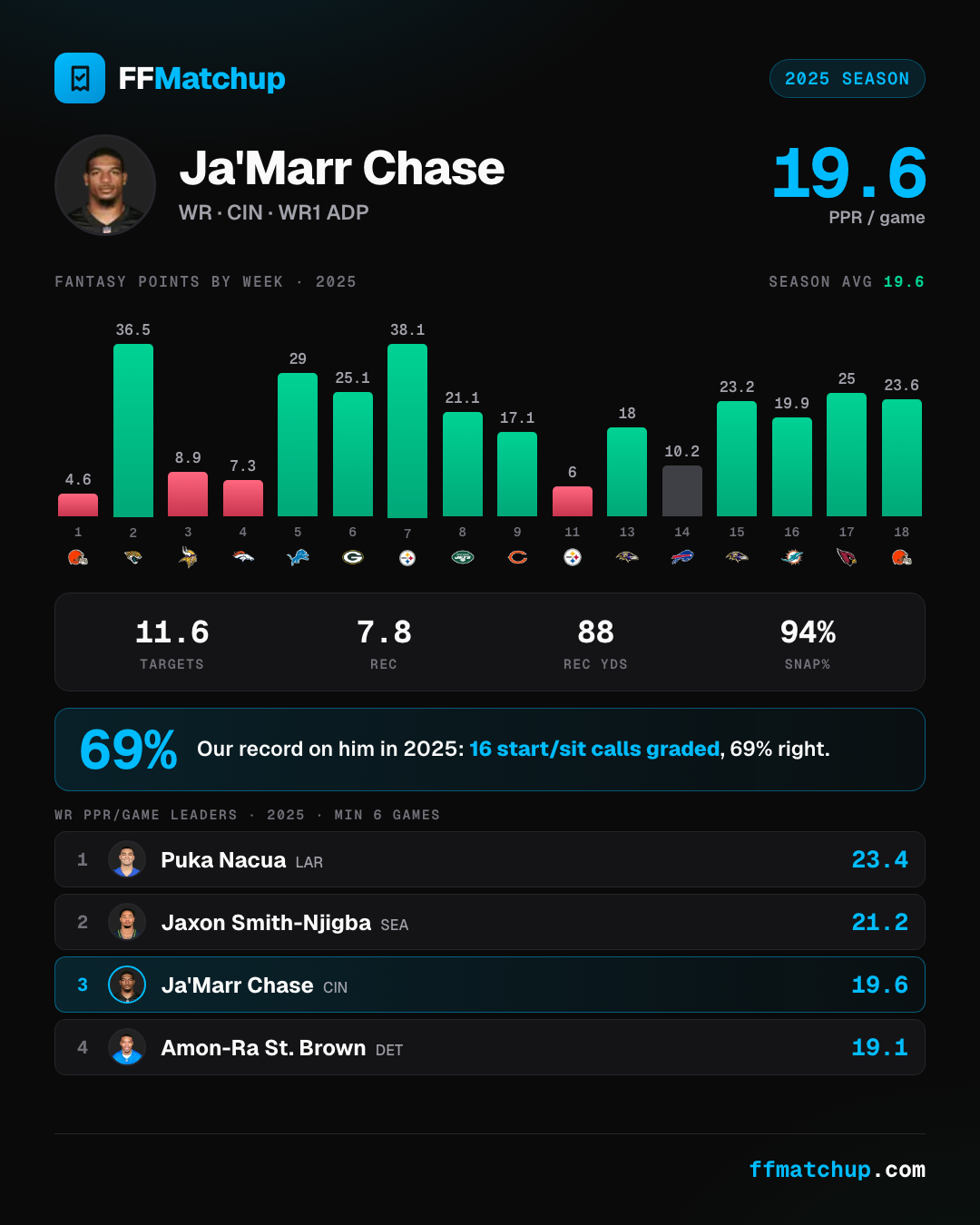
Ja'Marr Chase is the first receiver off the board in most drafts, and the reason is the part of his profile that repeats. In 2025 he played 16 games, caught 125 of 185 targets for 1,412 yards and 8 touchdowns, and scored 19.6 PPR points per game. The headline is the volume: he took a 32.1% target share while on the field for 94% of the snaps. That is the workload of a clear number-one option, and it is what you are actually buying at the top of the first round.
The volume is downfield, not manufactured
A big target share can be empty if it is all short throws. Chase's was not. He caught the ball at an 8.49-yard average depth of target, took a 34.4% share of the Bengals' air yards, and added 5.12 yards after the catch per reception. He also drew 29 deep targets, a 31.5% share of the team's downfield looks. That is the full profile: heavy volume, a real aDOT, downfield work, and yards after the catch. It is the usage that produces both the safe weeks and the ceiling weeks.
The Bengals-wins worry misreads how his fantasy value is built. Target share and air-yards share are offense-independent: they measure how much of his own passing game he commands, not the scoreboard. A team that trails throws more, not less, and Chase is the receiver those throws go to. His volume held whether Cincinnati was ahead or behind, which is exactly why the win total is the wrong thing to price.
The number that can still climb
Here is the two-sided part, and it cuts in his favor for once. Chase turned all that volume into only 8 receiving touchdowns in 2025. For a receiver with 185 targets, a 34.4% air-yards share, and a red-zone role (22 red-zone targets), that is a low finish, not a high one. Touchdown rate is the noisy input that swings year to year, and his came in below what the usage supports. The volume is already elite and repeatable; the scoring is the part more likely to rise than fall. You are not counting on a career year, you are counting on the same workload with a normal touchdown rate.
The receipts, week by week
Usage sets the range. Our graded calls test whether we read the individual weeks right, on the record. We called Chase startable in every one of his 16 games in 2025 and he cleared the line in 11 of them, including ceiling games of 38.1 points against Pittsburgh in Week 7, 36.5 against Jacksonville in Week 2, and 29.0 versus Detroit in Week 5. Across his full two-year graded history we sit at 24 of 33 (72.7%). Every call and every result is on his player page.
What it means for his 2026 price
Chase is going as the first receiver off the board, so this is not a buy-low. You are paying a top-of-the-first price for a top-of-the-first profile, and the workload earns it in the parts that stick: a 32.1% target share, a 34.4% air-yards share, and a downfield role that does not lean on his team winning. The one soft input, touchdown rate, is the one most likely to improve. Draft him where he goes and start him every week.